Underwriting in Investment Banking: Market Trends, Risk Assessment and the Changing Deal Environment in 2026
Investment banking capital-markets activity improved in the first half of 2026, although the recovery remained unusually concentrated. LSEG reported that the total value of global M&A transactions reached a record US$2.85 trillion in the first half of 2026, while transaction volume fell to a six-year low. In the United States, PwC reported that M&A value reached US$1.2 trillion in the first five months of the year, nearly double the comparable 2025 figure, even as transaction volume declined 4%. These patterns have changed the approach to underwriting in investment banking.
Thank you for reading this post, don't forget to subscribe!Larger transactions, complex financing structures, volatile interest rates, and divergent sector expectations require underwriting teams to assess not only whether a transaction is viable under a base case, but also how quickly its economics deteriorate when interest expense, revenue expectations, working-capital, or exit assumptions move against the investment thesis. As a result, underwriting now places greater emphasis on scenario analysis, downside protection, information quality, and transaction structure.
The 2026 Underwriting in Investment Banking Environment: More Capital, Greater Selectivity
High deal values are apparent from headlines; underwriting conditions are still tough underneath. Regional variation also means underwriting in investment banking must reflect local liquidity, regulation, and investor demand.
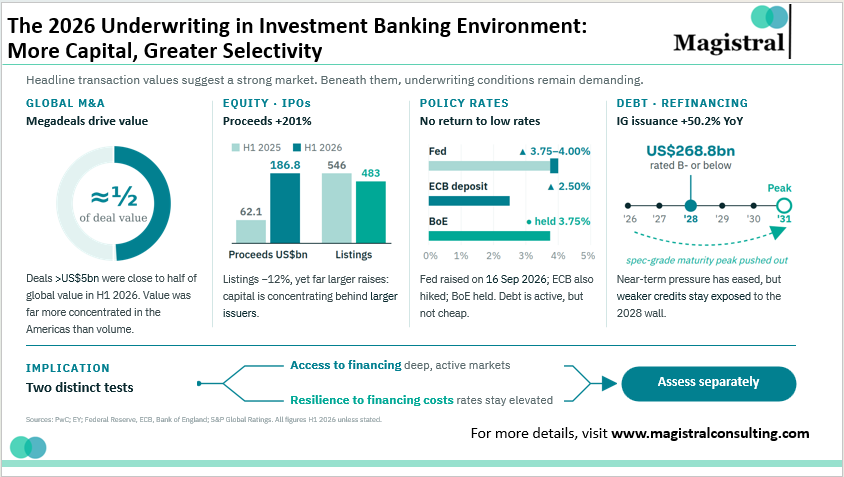
The 2026 Underwriting in Investment Banking Environment: More Capital, Greater Selectivity
An example from global M&A provides evidence of this dichotomy. Deals valued above US$5 billion accounted for nearly half of the global deal value in the first half of 2026, as revealed by PwC. The deal value was much more concentrated in the Americas region compared to the number of deals there.
The equity issuance activity is robust, too. As reported by EY, there were 483 global IPOs generating US$186.8 billion of proceeds in H1 2026, compared to 546 IPOs raising US$62.1 billion in H1 2025, a 201% increase despite a 12% reduction in the number of IPOs.
Debt markets are active, but funding costs have not returned to the low levels of the previous decade. On September 16, 2026, the Federal Reserve raised the target range for the federal funds rate to 3.75%–4.00%. The European Central Bank raised its deposit facility rate to 2.50%, effective September 16, while the Bank of England maintained the bank rate at 3.75% at its September meeting. These decisions reinforce the need to evaluate transaction economics under a range of financing-cost scenarios. Targeted external support can strengthen underwriting in investment banking by expanding analytical capacity during peak workloads.
Nevertheless, refinancing activity has been substantial. According to S&P Global Ratings, nonfinancial investment-grade issuance increased 50.2% from the first half of 2025, pushing the peak maturity year for speculative-grade bonds to 2031. Although near-term refinancing pressure has eased for most borrowers, weaker credits remain vulnerable; S&P identified US$268.8 billion of debt rated B− or lower that matures in 2028.
The underwriting implication is clear: financing availability and refinancing risk must be evaluated separately.
These pressures make underwriting in investment banking more demanding when information is incomplete, or market conditions shift quickly.
Underwriting in Investment Banking: How Assumptions Are Changing
A traditional base case model is not sufficient to evaluate transactions in 2026.
Downside scenarios are receiving greater weight. Revenue growth, margin assumptions, and valuation multiples need to be analyzed together rather than individually. A company that appears appropriately leveraged under management’s estimates may look substantially different if revenue growth slows and elevated financing costs persist.
Debt-service capability is receiving a more stringent test. Floating rate exposure, a refinancing schedule, and covenant cushion join leverage as key underwriting factors. Underwriting evaluation increasingly focuses on interest coverage, fixed charge coverage, free cash-flow yield, and liquidity in various capital structures.
Earnings quality is becoming more important than the headline EBITDA figure. S&P Global Ratings’ review of U.S. speculative-grade issuers found that EBITDA add-backs represented approximately 30% of market-adjusted EBITDA across a decade of data. This finding underscores the importance of validating adjustments, projected synergies, and management-defined earnings measures.
Cash-flow sustainability is also receiving greater emphasis. Working-capital seasonality, customer concentration, recurring versus project-driven revenue, capital-expenditure requirements, and contractual revenue recognition all affect whether accounting earnings support debt service.
Sponsor-led deals add another dimension to underwriting. In addition to operating performance, underwriters must assess the equity contribution, shareholder support, dividend capacity, and refinancing or exit potential. A deal that depends on multiple expansions or early refinancing has a substantially different risk profile from one that reduces debt through cash flow. As a result, underwriting in investment banking benefits from consistent data, transparent models, and clear escalation paths.
Regional Underwriting in Investment Banking
Regional underwriting approaches vary considerably across markets, reflecting differences in deal activity, financing conditions, regulatory frameworks, and investor appetite.
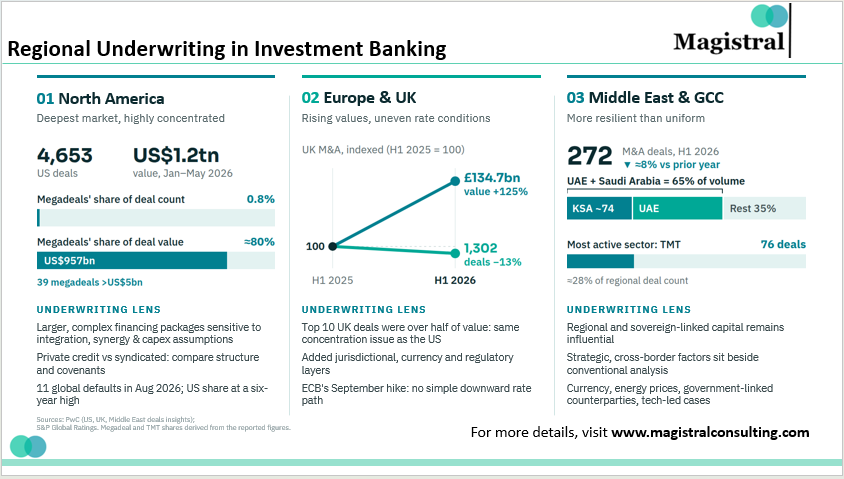
Regional Underwriting in Investment Banking
North America
North America continues to have the deepest transaction and financing markets, although activity is highly concentrated. According to PwC, 4,653 U.S. deals worth US$1.2 trillion were announced in the first five months of 2026. Of these, 39 transactions were valued at more than US$5 billion, and those megadeals represented US$957 billion of total value.
From a financing perspective, larger transactions are more difficult to finance and are especially sensitive to assumptions about integration, synergies, and future capital requirements. The availability of both private credit and broadly syndicated financing also makes comparisons of structures and covenants increasingly important.
Credit deterioration has not disappeared. S&P Global Ratings reported 11 global corporate defaults in August 2026 and stated that the U.S. share of global defaults reached a six-year high. Consequently, underwriting in investment banking increasingly depends on disciplined risk selection and evidence-based judgment.
Europe and the UK
Europe and the United Kingdom show rising average transaction values against an unsettled economic and interest-rate backdrop. In the United Kingdom, PwC estimated that first-half 2026 M&A value totaled £134.7 billion, an increase of 125% from the prior-year period, while transaction volume declined 12.6% to 1,302 deals. The ten largest transactions accounted for more than half of total deal value.
European underwriters therefore face the same concentration concerns as their U.S. counterparts, along with additional legal complexity, currency exposure, and cross-border execution risks. The ECB’s September rate increase also indicates that underwriters should not assume a smooth decline in European financing costs.
Middle East and GCC
Transactions in the Middle East have experienced more stability and resilience than consistency. PwC estimated 272 M&A transactions in the Middle East in H1 2026, 8% less than in the preceding year. In this period, the UAE and Saudi Arabia contributed 65% of total deal volume, and the number of deals in Saudi Arabia was around 74. Technology, media and telecommunications was the busiest industry, with 76 deals.
Regional and sovereign-related capital is still quite powerful. Hence, the underwriting process may consider such factors as strategy and cross-border issues, along with other financial factors, like the currency of the transaction, energy price risk, sovereign counterparties and, increasingly, technology-focused investment opportunities. For deal teams, underwriting in investment banking now requires earlier validation of assumptions and downside cases.
What Is Making Underwriting in Investment Banking More Difficult in 2026?
Scattered data is one of the biggest challenges. Financial data could be spread out in management accounts, audited statements, operating databases, virtual data rooms and third-party databases.
Challenging capital structures need an examination of senior debt, revolving credit lines, subordinated securities, preferred stock and other securities beyond the leverage ratio alone.
Refinance assumptions need more attention. Successful 2026 issuances have long maturities, yet some companies will still need considerable refinancing.
Disruptive trends are hard to forecast. Trends like AI, energy prices, geopolitics, and supply chain changes can affect business operations faster than financial statements can show.
Timelines for transactions have not improved. When due diligence, valuation, financing, and documentation all occur at the same time, more data must be processed without reducing the validity of the process.
Information consistency has also become an underwriting risk. EBITDA in a bank presentation may differ from EBITDA in the operating model; revenue projections may not reconcile with customer-level data; and management adjustments may materially change leverage calculations. These discrepancies require strong analytical skills and thorough review.
Magistral’s Support for Underwriting in Investment Banking
Magistral Consulting supports investment banks, private equity firms, private credit investors, and other financial institutions during underwriting and transaction evaluation. Its analytical support may include financial-statement analysis and spreading, company and industry research, peer and precedent-transaction analysis, financial modeling, scenario and sensitivity analysis, leverage and debt-capacity analysis, investment-banking due diligence, transaction research, preparation of underwriting and investment memoranda, data-room review, and ongoing portfolio or credit monitoring.
The objective is to operate as an extension of the client’s investment or transaction team by providing research and execution support, while final underwriting decisions remain with the client. Used carefully, technology can make underwriting in investment banking faster without weakening professional review.
About Magistral Consulting
Magistral Consulting has helped multiple funds and companies in outsourcing operations activities. It has service offerings for Private Equity, Venture Capital, Family Offices, Investment Banks, Asset Managers, Hedge Funds, Financial Consultants, Real Estate, REITs, RE funds, Corporates, and Portfolio companies. Its functional expertise is around Deal origination, Deal Execution, Due Diligence, Financial Modelling, Portfolio Management, and Equity Research
For setting up an appointment with a Magistral representative visit www.magistralconsulting.com/contact


Comments
Post a Comment