Real Estate Investor Reporting Outsourcing Guide
Real estate managers now face a reporting environment where investors expect speed, accuracy, transparency, and property-level clarity in every update. That pressure has grown as institutional real estate recovered unevenly across regions and transaction activity remained mixed across major markets. At the same time, CBRE projected 2025 investment volume growth of 8 percent in the United States, 15 to 20 percent in Europe, and 5 to 10 percent in Asia Pacific. Real estate investor reporting outsourcing helps fund managers handle this complexity without building large internal reporting teams. It brings accounting discipline, data control, valuation support, and investor communication into a scalable operating model.
Thank you for reading this post, don't forget to subscribe!Real estate investor reporting outsourcing and the market shift
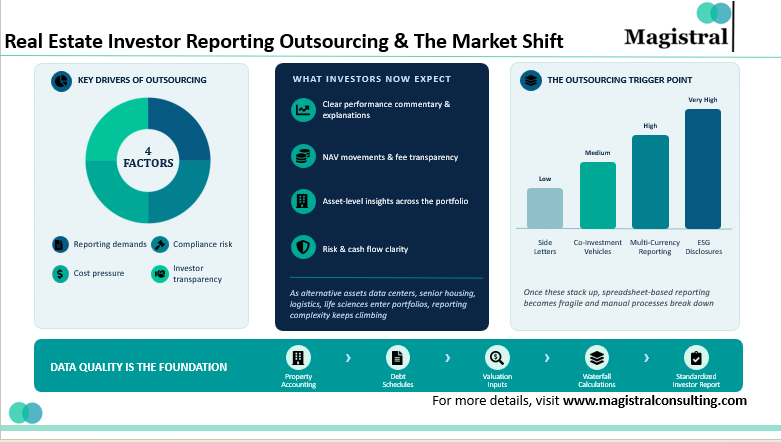
Real estate investor reporting outsourcing is becoming more strategic as capital moves toward specialized assets, private markets, and data-rich reporting. Investors no longer want generic quarterly PDFs. They want clean explanations of performance, risk, cash flow, and asset movement.
Real Estate Investor Reporting Outsourcing & The Market Shift
Why reporting expectations are rising
Institutional investors increasingly expect real estate reporting to provide clear performance commentary, NAV movements, fee transparency, and asset-level insights. As alternative assets such as data centers, senior housing, logistics, and life sciences grow, reporting becomes more complex, making integrated financial modeling and outsourced reporting support increasingly valuable.
The outsourcing trigger
Real estate investor reporting outsourcing typically begins when fund size, investor count, or reporting frequency exceeds the capacity of the internal team. A small team may be able to manage one closed-end fund manually. However, once side letters, co-investment vehicles, multiple currencies, and ESG disclosures are involved, spreadsheet-based reporting becomes fragile.
Reporting demands, compliance risk, cost pressure, and investor transparency are major reasons private real estate firms turn to third-party administration. This is not only about saving cost. It is about making reporting dependable.
Data quality as the foundation
Every investor report is only as reliable as the data behind it. Property accounting, debt schedules, leasing assumptions, capex plans, valuation inputs, and waterfall calculations need a clear review path. Outsourced teams help standardize data collection across property managers, accountants, valuation teams, and fund administrators.
For real estate funds, this structure matters because reporting errors can weaken trust quickly. A late distribution notice or inconsistent capital account statement may look small internally, but investors read it as a sign of weak control.
Real estate investor reporting outsourcing and operational efficiency
Real estate investor reporting outsourcing improves efficiency by separating routine reporting work from investment decision-making. Fund managers keep control of strategy while specialists manage repeatable reporting workflows.
Faster reporting cycles
Quarter-end often creates a bottleneck. Teams must close books, collect asset updates, validate debt data, update valuations, calculate investor allocations, and prepare commentary. Outsourcing shortens this cycle because the provider runs a calendar-driven process.
PwC’s 2025 asset and wealth management outlook warned that manual and time-consuming processes can slow AUM growth, especially when managers expand into retail alternatives and more complex distribution channels. That point applies directly to real estate. Growth requires operational capacity.
Better use of internal talent
Investment teams should spend more time evaluating deals, managing lenders, improving assets, and speaking with investors. They should not spend entire weeks reconciling capital calls or formatting investor letters. Real estate investor reporting outsourcing shifts recurring production work to a trained support layer.
The same logic applies to private equity operating models, where fund managers increasingly outsource repeatable finance, reporting, and transaction support tasks while keeping investment judgment in house.
Stronger controls and review trails
A mature reporting workflow includes maker checker reviews, source file tracking, version control, exception logs, and documented sign offs. These controls become essential when funds report to pension funds, sovereign wealth funds, family offices, and consultants.
Real estate fund administration outsourcing can support timely reporting, precise valuations, data integration, and operational handovers. That makes outsourcing a control decision as much as a staffing decision.
Real estate investor reporting outsourcing and investor communication
Real estate investor reporting outsourcing also improves the investor experience. Clear reporting reduces follow up questions and helps LPs understand what is happening inside the portfolio.
Turning numbers into a story
Imagine an investor reviewing a downtown office asset where occupancy improved but valuation fell because cap rates expanded. A raw number will confuse them. A strong report explains the story. It shows leasing progress, market yield movement, debt cost, and management action.
This is where valuation support becomes important. Investors need to understand not only the final NAV but also the assumptions behind it.
More transparent performance reporting
Real estate performance is rarely linear. Rent free periods, refinancing, development delays, tenant incentives, and capex can distort short term results. Outsourced reporting teams help present these movements consistently across periods.
MSCI found that global real estate investment volume was flat in the first quarter of 2025 after investment volume had increased by close to 50 percent year over year in the final quarter of 2024, showing how quickly uncertainty can affect transaction momentum. In this environment, investors value reporting that separates asset performance from market noise.
Custom reporting for different investor types
A family office may care about distributions and capital preservation. A pension fund may focus on attribution, leverage, ESG exposure, and benchmark comparisons. A consultant may need standardized templates across managers.
Real estate investor reporting outsourcing allows managers to create investor specific views without rebuilding every report manually. It also helps support capital raising because reporting quality often becomes part of operational due diligence.
Real Estate Investor Reporting Outsourcing & Future Readiness
Real estate investor reporting outsourcing is moving toward technology enabled reporting, stronger analytics, and closer integration with fund operations. The next phase will reward managers who combine clean data with clear communication.
Real Estate Investor Reporting Outsourcing & Future Readiness
Technology led reporting
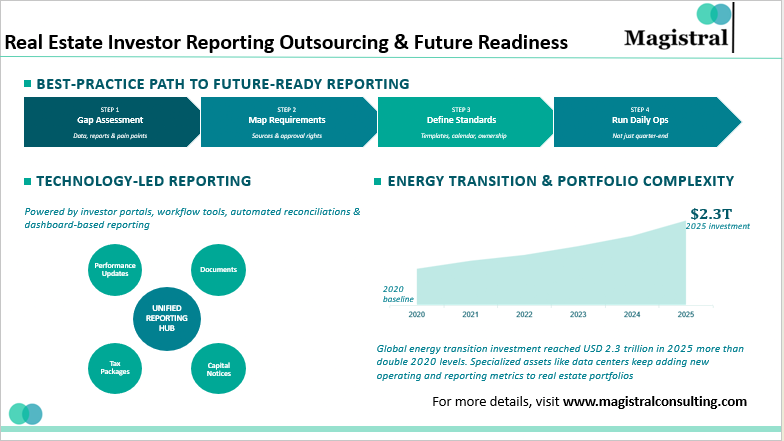
Modern providers use investor portals, workflow tools, automated reconciliations, and dashboard-based reporting. These systems reduce email traffic and create a single source of truth for documents, capital notices, tax packages, and performance updates.
Global energy transition investment reached USD 2.3 trillion in 2025, more than double 2020 levels. At the same time, growing demand for specialized assets such as data centers continues to add new operating and reporting metrics to real estate portfolios. As portfolios become more specialized, reporting systems must handle more complex operating metrics.
Best practices for implementation
Managers should start with a reporting gap assessment. They need to map current data sources, recurring reports, investor requirements, approval rights, and pain points. After that, they can define templates, reporting calendars, data ownership, and escalation rules.
Real estate investor reporting outsourcing works best when the provider supports daily operations, not just quarter end production. Teams that connect accounting, operations, modeling, and investor communication build a more resilient reporting platform.
How Magistral supports reporting needs
Magistral supports real estate managers with reporting packs, investor dashboards, fund accounting support, data room preparation, valuation assistance, capital account schedules, and portfolio performance tracking. Its teams help managers create repeatable reporting processes that are accurate, investor friendly, and scalable.
For managers preparing investor updates, fundraising materials, or operational review packs, capital raising becomes easier when reporting is clean, current, and defensible. Strong reporting does more than inform investors. It builds confidence before the next allocation decision.
About Magistral Consulting
Magistral Consulting has helped multiple funds and companies in outsourcing operations activities. It has service offerings for Private Equity, Venture Capital, Family Offices, Investment Banks, Asset Managers, Hedge Funds, Financial Consultants, Real Estate, REITs, RE funds, Corporates, and Portfolio companies. Its functional expertise is around Deal origination, Deal Execution, Due Diligence, Financial Modelling, Portfolio Management, and Equity Research
For setting up an appointment with a Magistral representative visit www.magistralconsulting.com/contact


Comments
Post a Comment