M&A Deal Origination: Turning Market Intelligence into Deals
Data-driven approaches have been an emerging trend in recent years for M&A deal origination, as global transaction volume is largely tilted toward capability M&A and companies using M&A deals to acquire technologies, AI infrastructure, customer bases, and market presence. The value of M&A transactions globally has increased by 36% in 2025, while the number of megadeals exceeding $5 billion has increased from 63 to 111, according to PwC. In 2025, there were 50,810 global M&A transactions worth almost $5 trillion, representing 37% YoY growth, according to PitchBook.
Thank you for reading this post, don't forget to subscribe!Under these circumstances, M&A deal origination requires less reliance on intermediaries to find business opportunities and a more systematic approach to identifying companies, assessing strategic fit, establishing relationships with company owners and managers, and contacting target companies before the sales process.
M&A Deal Origination Foundations and Market Context
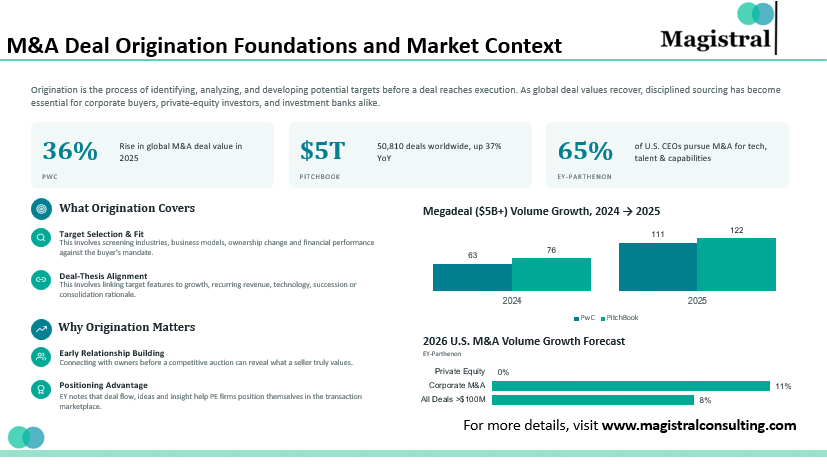
M&A deal origination is a set of actions related to identifying, analyzing, and developing potential targets prior to a deal becoming an execution one. The recovery of deal values on a global level is raising the importance of proper sourcing procedures for corporate buyers, private equity investors, and investment banks.
M&A Deal Origination Foundations and Market Context
What M&A Deal Origination Covers
M&A deal origination starts with the selection of targets that fit an investor’s or acquirer’s mandate. This includes analyzing industries, business models, ownership changes, financial performance, and strategic motivations of sellers.
The aim of a successful origination procedure is not merely to produce a long target list. An effective origination procedure links the features of a target to a particular deal thesis. Revenue growth, recurring income, geographic expansion, technology, customer concentration, succession issues, and consolidation can all serve as reasons for a deal.
Why Origination Matters in a Competitive M&A Market
The importance of origination becomes even greater when there is competition between several buyers for the same assets. According to EY, deal flow, ideas, and insights become important in helping private-equity companies position themselves in the transaction marketplace. Early awareness of potential opportunities helps build relationships with owners before a competitive environment starts.
This provides an advantage because creating a connection before any auction takes place allows a company to understand the seller’s priorities.
Global M&A Activity Has Shifted Toward Larger Transactions
According to PwC, the aggregate deal value of M&A transactions globally has increased by 36%, and the number of megadeals worth more than $5 billion increased from 63 in 2024 to 111 in 2025. Similarly, according to PitchBook, there were 50,810 deals worth almost $5 trillion in 2025, an increase of 37% over 2024.
Moreover, PitchBook stated that transactions worth more than $1 billion produced $2.6 trillion in value, which accounted for 56.6% of total global M&A value in 2025. Transactions with a value of more than $5 billion numbered 111, up from 63 in 2024.
This has significant implications for origination strategy. The larger the deal size, the stronger the need for better strategic logic and extensive target discovery. Therefore, buyers will need better market intelligence to find companies capable of driving change.
This has significant market implications for M&A deal origination teams.
Strategic Buyers Are Increasing Their M&A Activity
According to EY-Parthenon, deal volume in U.S. deals above $100 million will grow by 8% in 2026, with corporates’ M&A deal volume projected to grow by 11%, whereas private equity deal volume will remain broadly unchanged. According to EY-Parthenon’s survey data, 65% of U.S. CEOs are pursuing M&A deals to secure access to technology, talent, and operational capabilities.
This suggests that corporate deal origination is becoming more closely associated with transformation. The acquirer seeks companies with capabilities that it could develop in-house but can acquire quickly through M&A.
M&A Deal Origination Applications and Emerging Opportunities
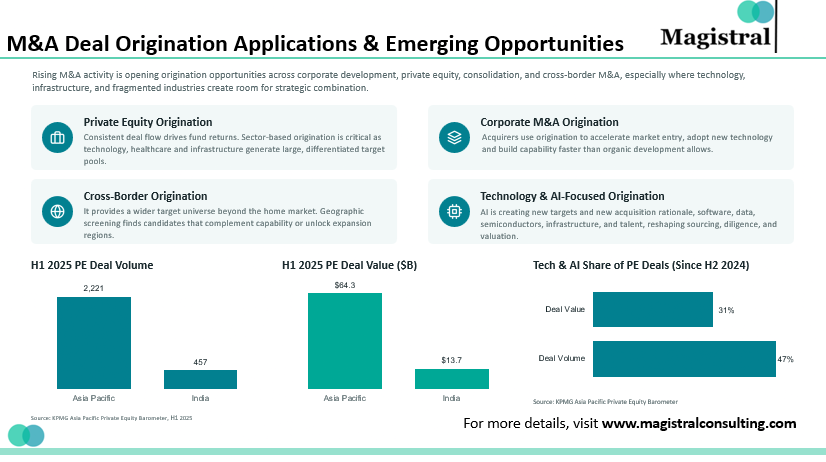
The growth of M&A activity is presenting opportunities for origination in corporate development, private equity, consolidation, and cross-border M&A. Origination becomes particularly relevant in those markets where technology, infrastructure, and fragmented industries make possible strategic combinations.
M&A Deal Origination Applications & Emerging Opportunities
Private Equity Deal Origination
Consistent deal flow is crucial for private equity firms since the returns from investments depend on the selection of companies that suit the investment fund’s mandate and value creation strategy.
According to the KPMG Asia-Pacific Private Equity Barometer, during H1 2025, the volume of Asia-Pacific private-equity deals increased by 4% to 2,221, whereas the total investment value declined to US$64.3 billion. In India, the high momentum continued with 457 PE deals valued at US$13.7 billion during H1 2025. The technology, infrastructure, and relatively stable regulatory framework drove the growth. Technology and AI represented 47% of deal volume and 31% of deal value since H2 2024.
The numbers provide an explanation as to why sector-based origination will become increasingly important. Technology, healthcare, infrastructure, and other emerging sectors will have large pools of targets, but firms will need differentiating screening criteria to find those that are relevant to them.
Corporate M&A Deal Origination
Companies that are interested in acquiring use the origination process to find companies that will help accelerate market penetration, adopt technologies, or develop capabilities.
According to EY-Parthenon, in 2026, deals involving amounts larger than $100 million will be up 8% in terms of volume, while corporate M&A deal origination will be up 11% in volume, with private equity deals remaining flat.
Cross-Border M&A Origination
Cross-border transactions have a broader target universe because there may be suitable acquisition candidates in other markets beyond the home market.
Geographic screening can help locate companies that have the ability to complement capabilities or reach customers in regions where the buyer is planning expansion.
The Asia-Pacific region is important from the standpoint of cross-border M&A deal origination. KPMG identified 2,221 private equity deals in the region worth US$64.3 billion during H1 2025, while India and Southeast Asia were gaining momentum and Japan was active in selective large transactions.
India saw strong private capital activity, with 457 PE transactions worth US$13.7 billion in H1 2025, according to KPMG.
Technology and AI-focused Origination
AI is creating new acquisition targets and new reasons for acquisition.
Businesses are acquiring software, data, semiconductors, infrastructure, and AI capabilities to further implement their technology strategies. According to PwC, AI is accelerating decisions relating to scale, capability, data, and talent, while BCG sees AI affecting sourcing, diligence, valuation, and negotiation.
This creates an increased need for mapping technology ecosystems, as well as traditional industry category mapping.
M&A Deal Origination Market Outlook
The outlook for M&A deal origination is intrinsically linked to the further consolidation of deal value in larger deals, robust corporate M&A deal origination, and the growing application of technology across the deal process. Origination is therefore becoming a strategic capability as well as a business development function.
M&A Value Is Expected to Remain Elevated
According to PwC’s mid-year outlook for 2026, M&A value is expected to be close to $4 trillion in 2026, which would represent the highest annual value seen since 2021 if maintained. The proportion of deals with values greater than $5 billion is expected to make up 48% of global deal value in 2026, compared with 39% in 2025 and 26% in 2024, reflecting the scale at which M&A deal origination takes place.
The data indicates that larger strategic transactions will dominate the market. This implies that origination teams will have to find companies with enough scale, strategic significance, or technology capability to justify acquisition.
The Americas Continue to Dominate Deal Value
The Americas, especially the U.S., maintain their dominance in large deal values, whereas PwC notes that the current market is increasingly taking a K-shaped trend, characterized by strength mainly among large, well-capitalized, and technology-driven buyers.
This trend presents a significant origination opportunity for firms focused on doing business with American or North American companies. Simultaneously, increasing deal values in the Asia-Pacific region present growing cross-border target discovery opportunities.
Origination Is Becoming a Data Infrastructure Function
Considering the use of ever-growing data sets in deals, origination teams depend on structured company information, transaction history, ownership intelligence, and real-time signals.
This evolution transforms the nature of an origination professional, who no longer only searches for firms. The origination team can now leverage data to discover potential target firms, qualify them, and develop relationships and investment theses.
How Magistral Consulting Helps in M&A Deal Origination
Magistral Consulting supports M&A deal origination and private-equity teams with research-driven deal origination and target identification. The support can include industry mapping, company screening, target profiling, financial analysis, market research, ownership research, comparable-company analysis, and preparation of target databases.
For private equity firms, the process can help identify businesses that match investment criteria across sectors, geographies, and financial thresholds. For corporate development teams, research can focus on acquisition targets that provide access to new markets, customers, technology, or operating capabilities.
Magistral can also support the analytical work surrounding outreach by preparing company profiles, investment rationales, financial snapshots, and relevant market intelligence. This allows internal teams to spend more time on relationship development, management discussions, and transaction strategy while maintaining a structured pipeline of potential opportunities.
About Magistral Consulting
Magistral Consulting has helped multiple funds and companies in outsourcing operations activities. It has service offerings for Private Equity, Venture Capital, Family Offices, Investment Banks, Asset Managers, Hedge Funds, Financial Consultants, Real Estate, REITs, RE funds, Corporates, and Portfolio companies. Its functional expertise is around Deal origination, Deal Execution, Due Diligence, Financial Modelling, Portfolio Management, and Equity Research
For setting up an appointment with a Magistral representative visit www.magistralconsulting.com/contact


Comments
Post a Comment