Outbound Investor Outreach for Fundraising Success
Outbound investor outreach has become an integral part of raising funds for early-stage startups, young managers, investment banks, and private market advisors. The money is out there, but investors are now pickier, data-driven, and focused on mandate fit. According to CB Insights, venture funding worldwide reached $469 billion in 2025, representing a 47% YoY growth, while deal count was down 17% to 29,501 deals. Companies in AI raised $226 billion, which represents 48% of all venture funding, while mega rounds captured $307 billion, or 65% of global venture capital.
Thank you for reading this post, don't forget to subscribe!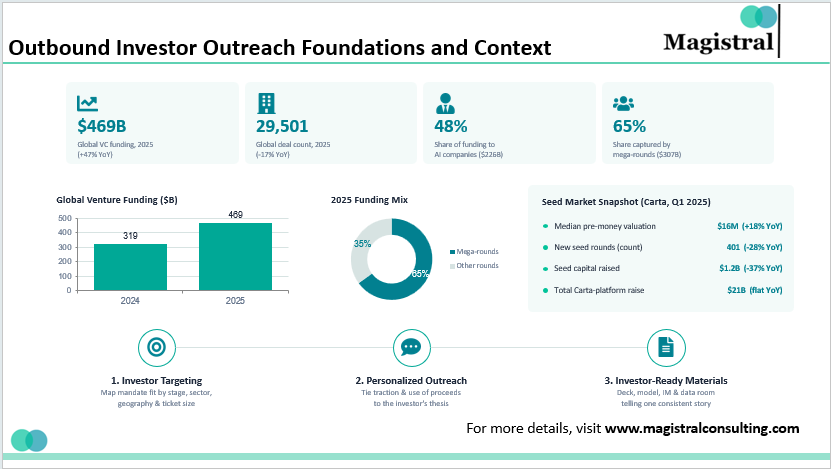
Outbound Investor Outreach Foundations and Context
According to Carta, the median pre-money valuation of seed rounds reached $16 million in Q1 2025, growing by 18% year over year, whereas the number of seed rounds decreased by 28%. Under these conditions, outbound investor outreach depends on correct investor targeting, proper positioning, personalized communication, a CRM approach, and follow-up. Outbound investor outreach is not mass mailing. Outbound investor outreach is a selective capital-raising process that involves identification and segmentation of relevant investors and engagement based on a credible reason for looking at your opportunity.
Investor Targeting Comes Before Messaging
The initial step in the process is investor-fit mapping. Seed rounds should not be targeted by late-stage growth capital funds, and a lower mid-market firm searching for buyout funding requires a totally different investor universe than a SaaS company raising venture capital. The relevance of an opportunity will lead to better responses, as investors screen deals on various parameters – stage, location, sector, ticket size, and portfolio concentration. The Magistral investor database helps in this regard by listing 5,000+ LPs, 17,000+ GPs, 6,500+ angel investors, and 6,500+ HNIs, with information on the type of company, location, contact names, email addresses, LinkedIn IDs, and physical address.
In that sense, outbound investor targeting becomes more systematic rather than through scattered networks or generic online databases.
Personalization Is Now the Baseline
Every investor receives hundreds of pitch emails in a month. Hence, the personalization must be much more than a simple first-name addition to an email. It must be done in such a way that the investor can see how the company’s sector, traction, round size, and use of proceeds fit into their mandate. However, according to the data from Carta for the first quarter of 2025 in the private market, good companies are still being noticed. Yet, deal count compression indicates that investors are now using higher-quality filters.
Startups on Carta have raised $21 billion in Q1 2025, which is consistent with Q1 2024, yet the volume of seed capital has reduced to $1.2 billion in 401 seed deals, representing a 37% reduction from Q1 2024. That makes outbound investor outreach a positioning as well as a distribution effort.
Materials Must Be Investor-Ready
Weak materials will not be saved by even the strongest email. The story told in the pitch deck, the teaser, financial modeling, data room, and information memorandum must be consistent. This is especially true in capital raising, where discrepancies in valuation, market size, traction, and use of funds might cause trouble in early-stage meetings. Magistral’s fundraising assistance consists of pitch deck development, valuation modeling, information memorandums, teasers, data room assistance, investor matching, CRM-based campaigns, follow-ups, scheduling, and closing deals.
Applications and Use Cases in Outbound Investor Outreach
The outbound process helps companies raise money in various situations, including startups, LP fundraising for funds, and others. In each situation, you will need a unique investor list, message, and conversion funnel. As the duplication of the above overview has been omitted, now we will consider only examples of use cases and segments of potential investors.
Startup Fundraising
In the case of startups, the process of outbound investor outreach is mostly related to angels, seed funds, micro-VCs, industry specialists, and strategic investors. The message here should be brief – problem, solution, traction, market, team, and fundraising request. According to CB Insights, the US has been able to attract $328 billion, which accounted for 70% of global venture capital investment in 2025, while Asia and Europe were able to attract $53 billion and $68 billion, respectively.
Fundraising for Funds
In the case of fund managers, outbound investor outreach usually goes out to LPs, including family offices, funds of funds, endowments, pension funds, sovereigns, and wealth management platforms. Outbound investor outreach needs more time since there are many factors that LPs consider, such as track record, team stability, DPI, strategy, portfolio construction, and infrastructure. Here comes the utility of the well-designed database of funds. According to Magistral, it will provide customized lead generation based on the type of investor, industry, and geography, and will offer 500 customized leads along with a subscription to its database within three weeks after signing.
Private Equity and Lower Mid-Market Deals
Outbound investor outreach for private equity usually assists in acquisition finance, growth equity, recapitalization, debt raise, or sponsor coverage. It includes the process of finding out those investors who have the relevant check size, sector interest, deal experience, and deployment capacity. The Q1 2025 Global Private Market Fundraising Report by PitchBook reported that there was a trailing-four-quarter private capital fundraising of $1.26 trillion, which declined 17.0% year over year, while the private debt fundraising increased 18.2% and secondaries fundraising increased 51.6%.
Debt and Private Credit Outreach
For debt outreaches, banks, private credit funds, specialty finance firms, and alternative lenders become targets of outreach. The main points of focus for such outreaches include cash flow, collateral, repayability, covenants, and protection from downside risks. The investor list needs to be smaller but deeper since the fit of lenders depends significantly on sectors, leverage, EBITDA, geography, and security structure.
Tools, Trends, and Technologies in Outbound Investor Outreach
The technology has impacted fundraising teams’ approach to list building, communication management, and tracking of investor behavior patterns. Still, tools become effective only if combined with thorough research and human discretion.
Investor Databases and Segmentation
The modern databases allow fundraising teams to segment investors based on location, sector, investment stage, fund type, investment size, and other details about decision-makers. Magistral’s database includes useful data on investors, such as email addresses, phone numbers, LinkedIn profiles, investor types, and geography. In addition, there is an option for analyst-driven customization of the database.
CRM and Outreach Automation
With a CRM, investor outreach can be measured. Tracking is performed on what has been done – who has been contacted, how and when they opened the deck, did they reply, follow up, and where does this particular investor stand in your pipeline. The fundraising approach at Magistral implies automation of personalized e-mail sequences, advanced triggers on opens, clicks, and replies, a real-time engagement dashboard, and follow-up scheduling.
AI-Led Research and Personalization
AI can help to profile investors, map industries, create emails, and evaluate engagement more quickly. However, AI can’t replace human judgment. The optimal usage of AI lies in identifying patterns and prioritizing investors based on relevance, and only after that, letting a human review the final version of the message. It reflects the general trend towards AI-powered deal origination, where the main advantage is automation and speed.
Engagement Analytics
Fundraising teams increasingly measure investor engagement through email open rates, deck opening, click-throughs, follow-up response, and meetings. Such measurement allows them to fine-tune messaging, prioritize warm leads, and avoid engaging uninterested investors. In a competitive market, the ability to measure such metrics can sometimes become more valuable than the list of investors itself.
Market Trends and the Future of Outbound Investor Outreach
Outbound investor outreach will become more targeted than mass based. Investors have more options, more data, and less time for anything irrelevant. As such, the fundraising team should be more specific, present cleaner material, and give a good enough reason to meet.
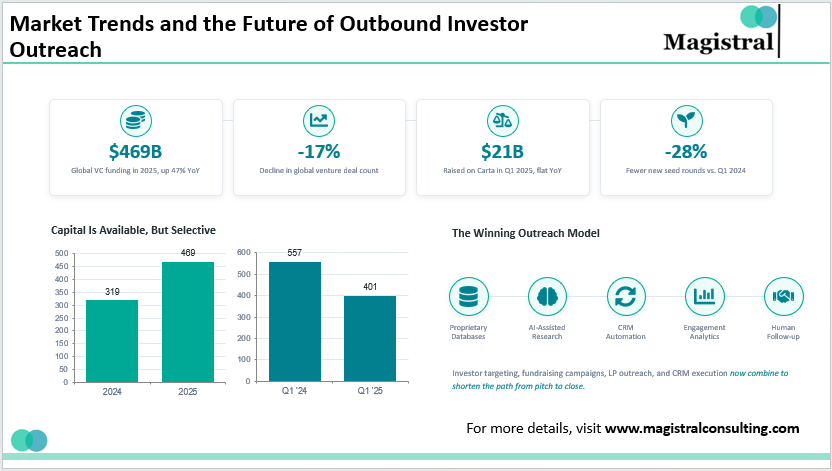
Two major trends in the fundraising world in 2025 can be identified. Firstly, there is money out there: CB Insights reported $469 billion worth of venture investments globally in 2025, 47% higher than the year before.
Market Trends and the Future of Outbound Investor Outreach
Secondly, the capital is highly selective: according to CB Insights, the number of venture deals decreased by 17%, while Carta reported that startups on its platform raised $21 billion in Q1 2025, roughly the same as in Q1 2024, but did 401 new seed deals, which is 28% fewer than the year before.
In the future, the successful model will be built using proprietary databases, AI-powered research, CRM process automation, investor outreach analysis, and top-notch human follow-through. For entrepreneurs, investors, and financial advisors, outbound investor outreach will always be among the most efficient ways to establish a fundraising process pipeline, gauge interest, and cut the time between pitching and closing.
For practical purposes of keyword planning, the article uses “outbound investor outreach” in controlled repetition within the body of the text without resorting to unnecessary repetition. The term is used in headlines and throughout the text where it fits the search intent context, while related keywords like investor targeting, fundraising campaigns, LP outreach, CRM implementation, and capital raising make the text readable.
Magistral’s Services for Outbound Investor Outreach
The company helps clients execute outbound investor outreach through a research-driven, CRM-led fundraising process supported by investor databases, offshore analysts, AI-powered workflows, and investment banking expertise. Its services include identifying and segmenting potential investors such as LPs, GPs, angels, HNIs, family offices, VCs, PE firms, strategic investors, and private credit providers based on geography, sector, stage, and fundraising requirements. The company also provides customized investor lists aligned with fundraising criteria, develops investor-ready materials including pitch decks, teasers, valuation models, CIMs, information memoranda, and data rooms, and manages CRM-driven outreach campaigns, follow-ups, engagement tracking, and workflow automation. Additionally, it supports investor meetings, NDA management, data room coordination, and deal closure activities.
About Magistral Consulting
Magistral Consulting has helped multiple funds and companies in outsourcing operations activities. It has service offerings for Private Equity, Venture Capital, Family Offices, Investment Banks, Asset Managers, Hedge Funds, Financial Consultants, Real Estate, REITs, RE funds, Corporates, and Portfolio companies. Its functional expertise is around Deal origination, Deal Execution, Due Diligence, Financial Modelling, Portfolio Management, and Equity Research
For setting up an appointment with a Magistral representative visit www.magistralconsulting.com/contact


Comments
Post a Comment