How a PE Fund Reduced Modeling Costs by 40% Using Outsourcing
The contemporary PE fund is constantly under the strain of assessing more opportunities, refreshing its valuation framework more quickly, and meeting higher demands from investors while maintaining the same level of fixed costs. This issue has been accentuated in recent years due to the reduced pace of fundraising activity and improved operational efficiency becoming an even larger point of differentiation. Under these circumstances, it became clear that outsourcing could serve as a useful tool for any PE fund looking to expand its analytical capabilities without jeopardizing margins. In a typical example, a particular PE fund was able to optimize its modeling process through the delegation of ongoing support for valuations, portfolio management, and presentations to an overseas unit, which allowed it to achieve a 40% reduction in modeling expenses, a 25% decrease in turnaround times, and a drop in error rate by approximately 30%.
Thank you for reading this post, don't forget to subscribe!PE Fund Foundations and Outsourcing Benefits
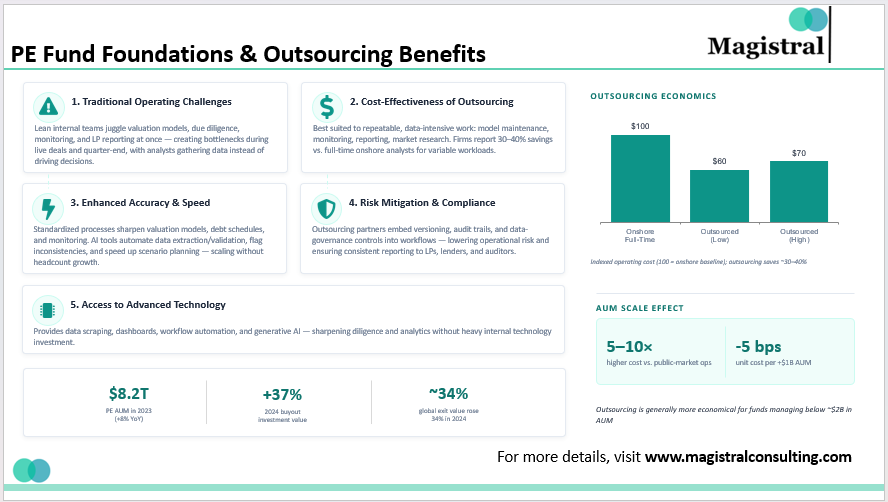
Additional market data reinforces the current operating environment for PE funds. Global private markets fundraising fell 22% in 2023 to just over USD 1 trillion, the lowest level since 2017, while private equity AUM still increased 8% to USD 8.2 trillion. In 2024, global buyout investment value rose 37% to USD 602 billion, and exit value increased 34% to USD 468 billion, although fundraising remained subdued. Preqin reported that private equity exits through the first three quarters of 2024 reached 80% of 2023 volume but only 54% of aggregate value, highlighting uneven liquidity recovery. reference
PE Fund Foundations & Outsourcing Benefits
Challenges in Traditional PE Fund Operations
Traditional PE funds often rely on lean internal teams to manage valuation models, due diligence, portfolio monitoring, lender materials, and LP reporting simultaneously. This creates bottlenecks during live deals and quarter-end cycles, with analysts spending significant time gathering data and updating models instead of supporting decision-making.
Cost-Effectiveness of Outsourcing
Outsourcing is most effective for repeatable, data-intensive activities such as model maintenance, portfolio monitoring, investor reporting, and market research. Many firms report cost savings of 30%–40% compared with hiring full-time onshore analysts for variable workloads.
A 2025 alternative-investment operations benchmark found that private-market operations cost 5–10 times more than comparable public-market operations due to manual reporting, compliance, and document handling. The study concluded that outsourcing is generally more economical for firms managing less than USD 2 billion in AUM and estimated that every additional USD 1 billion in AUM reduces unit operating costs by approximately 5 basis points.
Enhanced Accuracy and Speed
Standardized outsourcing processes improve the accuracy and efficiency of valuation models, debt schedules, and portfolio monitoring. AI-enabled tools can automate financial data extraction and validation, identify inconsistencies, and accelerate scenario planning, enabling PE funds to scale operations without proportional headcount growth.
Risk Mitigation and Compliance
Outsourcing partners can embed structured controls around versioning, auditing, and data governance into modeling and reporting workflows. This reduces operational risk and supports consistent reporting to limited partners, lenders, auditors, and other stakeholders.
Access to Advanced Technology
Outsourcing provides access to capabilities such as data scraping, dashboard analytics, workflow automation, modeling platforms, and generative AI tools. These technologies improve due diligence efficiency, reduce manual processing, and strengthen analytical capabilities without requiring significant internal investment.
Applications/Use Cases of Outsourcing in PE Funds
Private equity funds increasingly use outsourcing to support high-impact functions across the investment lifecycle. External teams can build and maintain portfolio company financial models, including valuation, debt, and scenario analyses, enabling faster updates for portfolio monitoring and exit planning. Outsourcing also streamlines investor reporting and CRM management by keeping LP communications, fundraising trackers, and distribution lists current. In due diligence, outsourced analysts conduct market research, competitive mapping, industry analysis, and preliminary ESG assessments, allowing deal teams to focus on investment decisions. Fundraising support functions such as pitch book creation, teaser preparation, and data room management can also be delegated, while dedicated analysts enhance scenario and sensitivity analyses by rapidly evaluating changes in revenue, margins, leverage, and exit assumptions.
Tools, Trends, and Technologies Supporting PE Fund Outsourcing
Tools, Trends, and Technologies Supporting PE Fund Outsourcing
AI and Automation
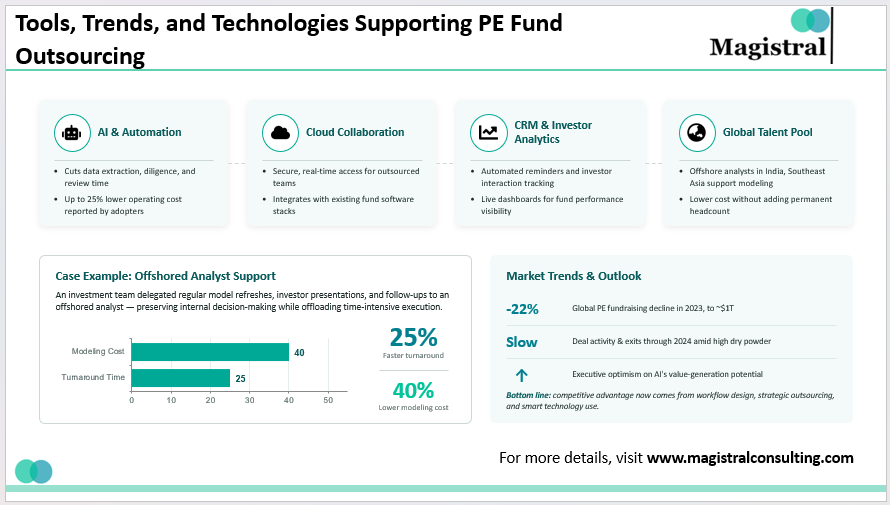
Advances in artificial intelligence will continue to enhance information-processing capability within the private equity industry, particularly in data extraction, portfolio management, and diligence workflow. Research conducted on private market firms in 2024 and 2025 suggests that firms are using AI technology to cut down on processing times, increase efficiency in reviewing opportunities, and generate improved decision support. Operating cost savings of up to 25% have been reported by some market players thanks to the deployment of sophisticated AI tools. Improvements in data quality and speed have also been cited by some as benefits of using AI.
Broader outsourcing data also suggests that AI-enabled service delivery is moving into the mainstream. Deloitte’s 2024 Global Outsourcing Survey, based on responses from more than 500 executives, found that 83% of organizations are already using AI as part of outsourced services, 25% reported reductions in vendor service costs or improvements in service quality, and 70% had selectively insourced some previously outsourced work over the prior five years as they rebalanced delivery models. For a PE fund, this indicates that the best operating model is often not purely offshore or purely internal, but a hybrid structure in which internal teams retain control over investment judgment while outsourced specialists handle repeatable analytics and reporting tasks.
Cloud-Based Collaboration
With secure cloud computing technology, outsourcing companies can collaborate effectively, keep records, and ensure confidentiality. In combination with current fund software, a smooth workflow is enabled.
Advanced CRM & Investor Analytics
The use of CRM technology with automated reminders, analysis of investor interaction, and dashboards is one of the advantages offered by outsourced companies.
Global Talent Pool
Access to a global labor market lets the fund benefit from additional outsourcing services without having a full-size permanent staff. Analysts located, for instance, in India or Southeast Asian countries can be hired to model financial performance, conduct research, manage information, and perform routine reporting at a fraction of the cost.
Case Example
An example case study further explains the effect. Through the delegation of regular model refreshes, investor presentations, and follow-ups to an offshore analyst, a certain investment team managed to shave turnaround time by about 25%, and cut down modeling costs by 40%. For a developing PE firm, such an approach helps create a flexible business model where internal employees continue making assumptions and decisions but outsource laborious tasks to external assistance.
Market Trends and the Future of PE Fund Outsourcing
The outsourcing process of PE funds cannot be seen as something marginal anymore, as it becomes an integrated part of an updated operational framework design. This phenomenon can be explained through market trends and dynamics. According to a study by McKinsey, the fundraising in global private markets shrank 22% in 2023 to a level of about USD 1 trillion, and according to Bain & Company, deal activity and exits were slow for most of 2024 due to plenty of dry powder available on the market. Simultaneously, there is growing technology adoption. FTI Consulting noted that private equity executives were increasingly optimistic about AI’s potential in value generation and decision-making, while additional surveys demonstrated the application of AI to reduce manual processes and improve analytical throughput. In the context of a PE fund, the key learning point is simple – a source of competitive advantage should come from effective workflow design, strategic outsourcing, and efficient technology use.
In 2024, the median holding period for private equity (PE) assets sold dropped to 5.8 years, indicating a slight easing of the exit backlog, although the median for PE-backed companies remained high at 3.4 years, with over 30% held for at least five years. Additionally, global exits rose by 22% to 1,470, yet approximately 29,000 companies remained unsold, prompting funds to focus on scalable execution, quicker diligence, and cost-effective models like selective outsourcing.
How Magistral Consulting Helps in PE Fund Outsourcing
Magistral Consulting is an organization that assists private equity funds by optimizing efficiency and lowering costs through the process of outsourcing. Magistral offers specific offshore teams specializing in financial modeling, investor reporting, and CRM management, together with the use of advanced artificial intelligence-powered analytics to speed up the valuation and scenario analysis process. Additionally, Magistral Consulting assists venture capitalists in making their investor outreach processes more efficient through pitch deck development, communications campaigns, and data room management. Magistral enables venture capital and private equity firms to effectively scale while reducing costs by significantly.
About Magistral Consulting
Magistral Consulting has helped multiple funds and companies in outsourcing operations activities. It has service offerings for Private Equity, Venture Capital, Family Offices, Investment Banks, Asset Managers, Hedge Funds, Financial Consultants, Real Estate, REITs, RE funds, Corporates, and Portfolio companies. Its functional expertise is around Deal origination, Deal Execution, Due Diligence, Financial Modelling, Portfolio Management, and Equity Research
For setting up an appointment with a Magistral representative visit www.magistralconsulting.com/contact


Comments
Post a Comment