Rent Rolls: Market Size, Growth Trends, and Insights
The financial analysis of real estate assets depends on rent rolls, which deliver essential information about income stability, tenant quality, and property performance. They supply investors with detailed information that they need to evaluate risks and estimate returns when they study multifamily properties and commercial real estate. The value has increased in recent years because institutional investors and global funds now use data-based methods for making investment choices. They have transformed from unchangeable records to active financial resources through the growth of digital property management systems and analytical software. The transformation has increased their importance in the underwriting process, the valuation process, and the due diligence process, which operates throughout the global real estate market.
Rent Rolls in Real Estate Financial Analysis
The foundation of property income assessment begins with rent rolls, which provide the essential dataset. The tenant data includes information about lease agreements, rental costs, and occupancy status, which enables investors to evaluate present performance and upcoming growth potential.
Understanding the Structure
A typical rent roll includes tenant names, lease start and end dates, monthly rent, and payment status. The structured dataset enables analysts to detect income concentration risks together with lease expiration patterns.
Role in Investment Decision Making
Investors use them as their main tool to confirm existing cash flow predictions. While performing real estate financial modeling, analysts use rent roll information to create precise revenue estimates and conduct sensitivity studies.
Rent Rolls in Due Diligence
The process of verification for seller statements requires them during acquisition transactions. The system helps identify discrepancies between unpaid rents and actual occupancy percentages, which enables transparent transaction handling.
Link with Institutional Investments
Large funds increasingly depend on standardized rent roll formats to compare assets across geographies, improving portfolio allocation decisions.
Rent Rolls Market Size and Growth
The ecosystem has expanded because people increasingly depend on structured property data, which fuels growth in both prop tech markets and real estate analytics markets.
Global Market Size Overview
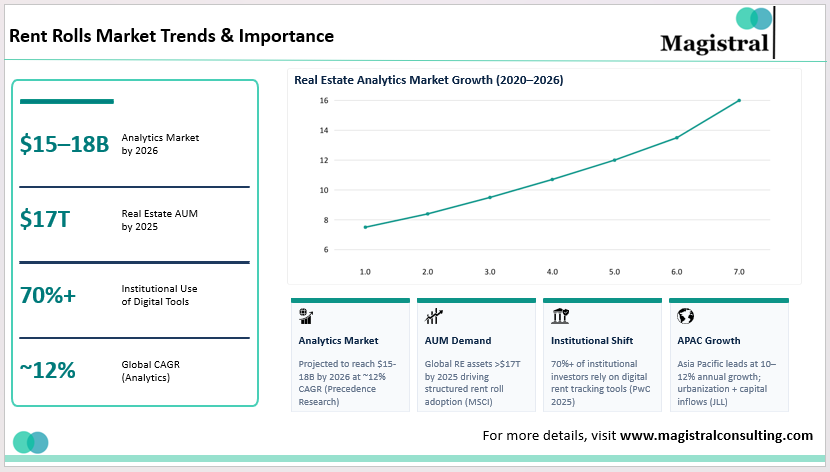
The global real estate analytics market, which includes rent roll management solutions, reached a market value of over $12 billion in 2024, according to Precedence Research and Deloitte. Property investment needs require increased data transparency and digital reporting systems, which drive this market expansion.
Growth Drivers Behind Rent Rolls Adoption
Real estate institutions have increased their investments, which has led to more companies using them for their operations. According to MSCI reports, the global real estate assets under management reached more than $15 trillion in 2024, which created a strong demand for standardized income tracking systems.
Technology Integration and Expansion
Cloud-based property management systems now provide property managers with real-time dashboard access to all rent roll data. The platforms let investors track their rent collection status, their lease contract timelines, and their tenant danger levels.
Regional Growth Trends
North America maintains dominant real estate market control, which exists because of its developed markets, while Asia Pacific experiences fast growth through urbanization and rising private equity investment in real estate.
Rent Rolls Trends and Recent Developments
The development shows the real estate industry transformation that occurs because of digital technology and predictive analytics. reference
Rent Rolls Market Trends & Importance
Digital Transformation
The current operation of modern rent rolls establishes an active system that establishes automatic property management software connections for real-time system updates and reporting.
AI and Predictive Analytics
AI tools now analyze rent roll data to predict tenant defaults and optimize rental pricing strategies. The trend reflects how venture capital-backed prop tech startups increasingly embrace analytics through their current business development strategies.
Increased Demand for Transparency
Investors demand greater transparency in property performance. Rent rolls provide detailed visibility into tenant behavior, which helps stakeholders to make informed decisions.
Regulatory and Compliance Influence
Standardization has become essential because European and North American regulatory frameworks require organizations to maintain exact financial records.
Rent Rolls’ Importance in Investment Strategy
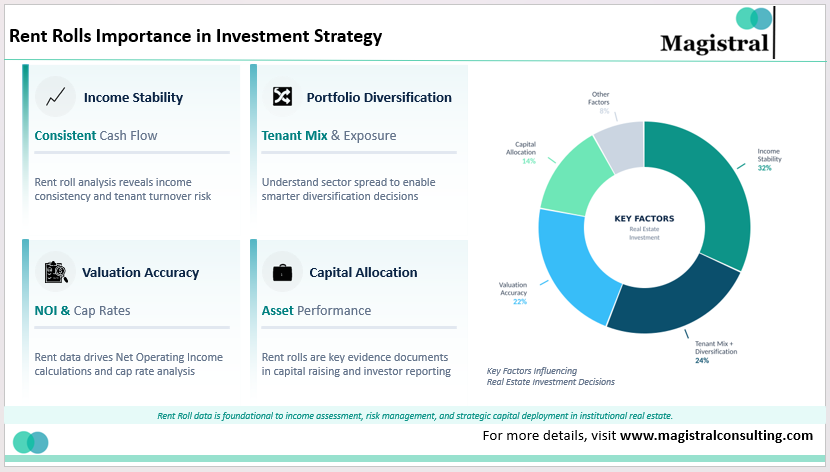
The strategic value functions as a critical element that determines which investment choices investors will make for their income-driven real estate investment portfolios.
Rent Rolls Importance in Investment Strategy
Income Stability Assessment
Investors use rent roll analysis to examine how stable their rental income streams are while they assess the risks that stem from tenant expirations.
Portfolio Diversification Insights
They enable investors to assess their tenant composition and sector distribution, which helps them develop appropriate diversification methods.
Valuation and Pricing Accuracy
The property valuation process depends on accurate rent roll data, which analysts require to determine net operating income and capitalization rates.
Role in Capital Allocation
It functions as essential documentation in capital raising processes because they prove how assets perform to prospective investors.
Rent Rolls Data Challenges and Risk Factors
The analysis presents two fundamental challenges because the required operational and analytical functions of rent roll management become more daunting with the rising complexity of real estate assets.
Data Inconsistencies
The rent roll data includes multiple inaccuracies, which create problems throughout the entire rent roll database. The most common problem emerges when property information uses different standards to display its data. The different rent roll formats used by property managers make it hard to merge their data into one system. The inconsistent data presentation results in incorrect financial assessments, which show both rental income and property occupancy rates.
Risk of Inaccurate Tenant Information
The presence of incorrect tenant data creates problems for financial forecasting because it includes wrong lease details and outdated billing information. The small errors present in the data create major discrepancies for valuation because they multiply throughout the entire portfolio assessment.
Challenges in Manual Rent Roll Management
The process of handling them through manual methods creates a higher chance of making mistakes. Deloitte’s 2025 prop tech insights show that businesses that depend on manual operations face 25% more data errors than organizations that implement automated processes.
Impact on Investment Decisions
The use of inaccurate rent roll information leads to underwriting errors because it creates wrong assumptions. The investors will generate excessive income predictions while they will make insufficient vacancy risk assessments, which will result in negative outcomes for both their business deals and their asset management operations.
Need for Standardization and Automation
The firms are implementing standard templates and automated validation systems to solve their current operational challenges. The system provides real-time data updates through its analytics platform integration, reducing the need for manual operations and improving data accuracy.
How Magistral Supports Rent Rolls Analysis
The process needs assistance, which is provided in the form of specialized support.
Data Standardization and Accuracy
Magistral systems check and arrange the rent roll information to reduce data errors, which might affect investment choices.
Advanced Analytics Integration
Firms use financial models together with rent roll data to create a better understanding of their asset performance and risk exposure.
Support for Institutional Investors
Global funds and asset managers use outsourced rent roll analysis to achieve better operational processes and faster decision-making.
Enhancing Operational Efficiency
Companies that outsource their rent roll management work achieve two advantages, which include better operational results and precise data management.
About Magistral Consulting
Magistral Consulting has helped multiple funds and companies in outsourcing operations activities. It has service offerings for Private Equity, Venture Capital, Family Offices, Investment Banks, Asset Managers, Hedge Funds, Financial Consultants, Real Estate, REITs, RE funds, Corporates, and Portfolio companies. Its functional expertise is around Deal origination, Deal Execution, Due Diligence, Financial Modelling, Portfolio Management, and Equity Research
For setting up an appointment with a Magistral representative visit www.magistralconsulting.com/contact


Comments
Post a Comment