Due Diligence Outsourcing Under Tight Deal Timelines
In 2026, deal teams are moving through a market where speed and confidence kind of must walk together, like if one slips, the other does too. Deloitte’s 2026 M&A Trends Survey noted that 90% of private equity respondents and 80% of corporate respondents expect their organizations to complete more deals in 2026. So naturally, there’s more pressure on diligence teams to answer fast, but not at the expense of solid analytical depth.
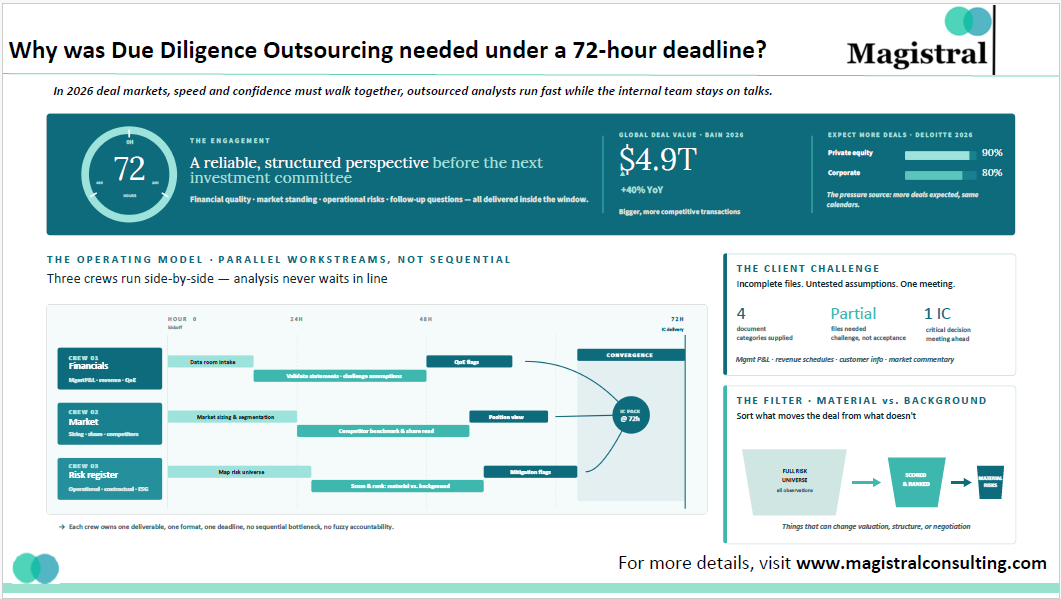
In this engagement, the client needed due diligence outsourcing help within 72 hours to check financial quality, market standing, operational risks, and collect key follow-up questions. The timeline was tight, but the goal was not fuzzy: provide decision makers with a reliable, structured perspective before the next investment committee discussion.
Why was Due Diligence Outsourcing Needed Under a 72-hour Deadline?
A 72-hour diligence window leaves almost no space for slow document review, vague ownership, or scattered analysis. Bain’s 2026 M&A Report notes that global deal value reached $4.9 trillion, up 40%, suggesting that buyers are returning to larger and more competitive transactions. In this environment, due diligence outsourcing makes sense because outside analysts can quickly review deal documents, run market research, validate financial statements, and map key risks while the internal team stays focused on negotiations and decision-making.
Why was Due Diligence Outsourcing needed under a 72-hour deadline?
The client challenges
The client had limited time to review the target before a critical decision meeting. The materials included management financials, revenue schedules, customer information, and early market commentary. Still, several files turned out to be incomplete, and some assumptions needed to be challenged, not just accepted. So, the first step was to spell out what could realistically change valuation, influence deal structure, or affect next-stage negotiations.
The market context
In Bain’s 2026 M&A Report, the report says the global deal market value hit $4.9 trillion, up 40%, suggesting buyers are returning to larger, more competitive transactions. In a setup like this, investors can’t afford to wait for some “perfect” data room. They need a diligence process that quickly distinguishes material risks from background chatter, particularly when they are looking at fast-moving private equity opportunities.
The operating model
For the engagement, they ran a parallel workstream approach. Basically, one crew went through the financials, another group looked at the market situation, and the third team built the risk register. This made things quicker because the analysis didn’t sit and wait for one item to finish before the next one started, if you know what I mean. It also upped the quality since each workstream had a clear, accountable owner, a defined deliverable format, and a deadline that mattered.
How Due Diligence Outsourcing Structured the First 24 Hours?
The first 24 hours were mostly about control, a bit of clarity, and where to prioritize, really. In due diligence outsourcing, the team sort of built a diligence tracker, and they tagged every source, then they figured out what info was missing, and they put together a quick set of questions for management, just to keep things moving. That early setup mattered because quick diligence gets shaky when analysts start chasing every tiny detail, instead of sticking to the decision-critical pieces.
Data room review
They went through the data room and sorted documents into revenue, cost, customer, balance sheet, market, and management buckets, like that. Every file got a reliability label based on whether it was pulled from audited statements, management estimates, third-party materials, or internal schedules. That made it easier for the client to see what was genuinely supported and what was more like a lead that still needed extra confirmation.
Financial normalization
Next, the financial review looked at revenue growth, gross margin, EBITDA adjustments, working capital movement, and cash conversion. They also tested whether the management adjustments felt like a repeat pattern, a one-time change, or something more aggressive. This step ties straight into valuation, because normalized earnings can shift the whole pricing conversation in a meaningful way.
Early risk signals
On day one, they flagged a handful of issues that needed deeper review, including customer concentration, margin volatility, delayed receivables, and limited visibility into recurring revenue. None of those points by themselves automatically killed the deal. Still, each item needed a clean follow-up question, so the client could stress test the risk before going further, you know.
How does Due Diligence Outsourcing Accelerate Analysis in the Next 24 Hours?
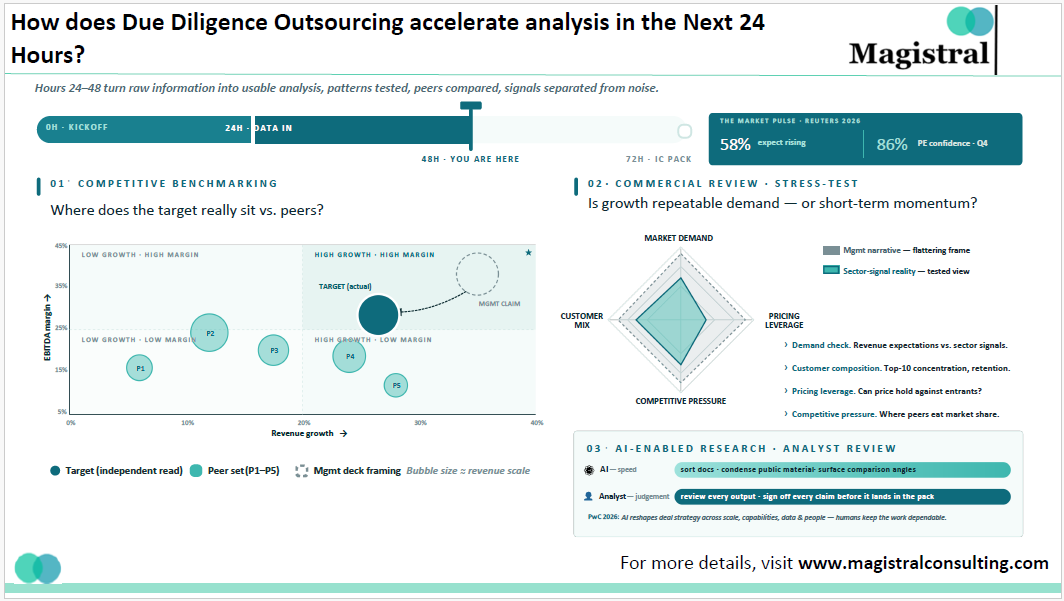
The second 24 hours turned raw information into something like usable analysis. The team went through the financial patterns, tried the commercial assumptions, compared the target with peer players, and sort of wrapped it all into a market snapshot. Reuters said in 2026 that 58% of surveyed executives expected M&A volume to rise, while 86% of private equity firms showed confidence in how they would handle M&A decisions in the fourth quarter. With activity like this, fast, accurate due diligence outsourcing becomes even more relevant for investors juggling multiple live opportunities at the same time.
How does Due Diligence Outsourcing Accelerate Analysis in the Next 24 Hours?
Commercial review
The commercial review basically stress-tested the target’s growth narrative against market demand, customer composition, pricing leverage, and competitive pressure. They checked whether management’s revenue expectations felt credible next to sector signals. That step made it easier for the client to judge if growth is coming from repeatable demand or more from short-term momentum.
Competitive benchmarking
The team charted competitors, lined up positioning, and reviewed what market indicators were available. This matters a lot because management decks tend to frame the target in the most flattering light, so it’s easy to get a skewed view. A solid benchmark approach helps investors form a more balanced picture, and it also backs deal support during negotiations that are already moving quickly.
AI-enabled research with analyst review
AI tools helped sort documents, condensed public material, and spotted quick comparison angles. Still, analysts reviewed every output before it ever went into the final pack. PwC’s 2026 M&A commentary mentions that AI is reshaping deal strategy and execution by shaping decisions around scale, capabilities, data, and people. Here, AI speeds things up, while the human review keeps the work dependable and correct.
How Magistral Supports Due Diligence Outsourcing for Faster Deal Decisions
Magistral helps deal teams with financial analysis, market research, data room review, risk tracking, management questions, and investment memo support. The 72-hour engagement showed how a focused process can help investors move faster without losing quality. It also gives senior teams more room to focus on judgment, negotiation, and decision-making.
The final report highlights key facts, risks, open questions, and next steps for investment committees, lender discussions, and capital raising conversations. The delivery worked because the team focused on what mattered most: financial quality, market reality, operational risk, and management follow-ups. That is the value of due diligence outsourcing: faster execution with stronger deal discipline.
About Magistral Consulting
Magistral Consulting has helped multiple funds and companies in outsourcing operations activities. It has service offerings for Private Equity, Venture Capital, Family Offices, Investment Banks, Asset Managers, Hedge Funds, Financial Consultants, Real Estate, REITs, RE funds, Corporates, and Portfolio companies. Its functional expertise is around Deal origination, Deal Execution, Due Diligence, Financial Modelling, Portfolio Management, and Equity Research
For setting up an appointment with a Magistral representative visit www.magistralconsulting.com/contact


Comments
Post a Comment