Outsourcing vs Hiring In-house: Smart Cost Comparison
A longer view changes how companies evaluate headcount. A role that looks affordable on salary alone can become much more expensive once recruitment, benefits, software, equipment, manager time, training, and replacement costs are included. Outsourced delivery can also look simple at first, but the real value depends on scope clarity, governance, and service quality. That is why outsourcing vs hiring in-house is not just a staffing choice. It is a cost, speed, utilization, and control decision. The broader market reflects that shift: the global outsourcing services market was estimated at USD 3.8 trillion in 2024 and is projected to reach USD 7.11 trillion by 2030.
How outsourcing vs hiring in-house changes the total cost base
A realistic comparison of outsourcing vs hiring in-house goes beyond salary versus vendor fees. Companies must also account for benefits, payroll taxes, recruitment, training, software, office setup, manager oversight, and idle capacity.
Internal hiring often creates the highest cost burden in the first year because employees require recruitment, onboarding, training, and ramp-up time before reaching full productivity. According to SHRM benchmarks, the average cost to hire one employee in the U.S. is around USD 4,700, excluding training and productivity losses.
In Outsourcing vs hiring in-house, in-house hiring works best when workload demand is stable and utilization remains consistently high. However, many businesses experience fluctuating workloads due to deal flow, reporting cycles, or project-based work. Outsourcing offers greater flexibility because companies pay only for the capacity they need.
Attrition also affects long-term cost. When employees leave, firms incur additional hiring, onboarding, and knowledge-transfer expenses. Outsourcing providers can reduce this dependency through documented processes, backup teams, and cross-trained staff.
What outsourcing vs hiring in-house means for productivity and risk
Cost is not the sole determining factor in outsourcing vs hiring in-house either. There is a need to consider productivity levels, delivery times, and managerial efficiencies. Organizations sometimes find themselves in a situation where there is a need for rapid scaling up that cannot be accommodated within the traditional hiring period, especially for projects like financial modeling, market research, benchmarking, and reports.
There are also costs associated with internal hiring in terms of productivity. The management has to engage in supervision, training, evaluation, and other management activities that may end up distracting the management from making decisions. New hires also take time before they can contribute productively.
This is where outsourcing comes in as a strategy that cuts down on such delays as it provides pre-formed teams with the necessary experience in delivery. Outsourcing also has the advantage of providing access to a more controlled environment regarding culture and information, as well as decision making.
A practical outsourcing vs hiring in-house cost model for finance teams
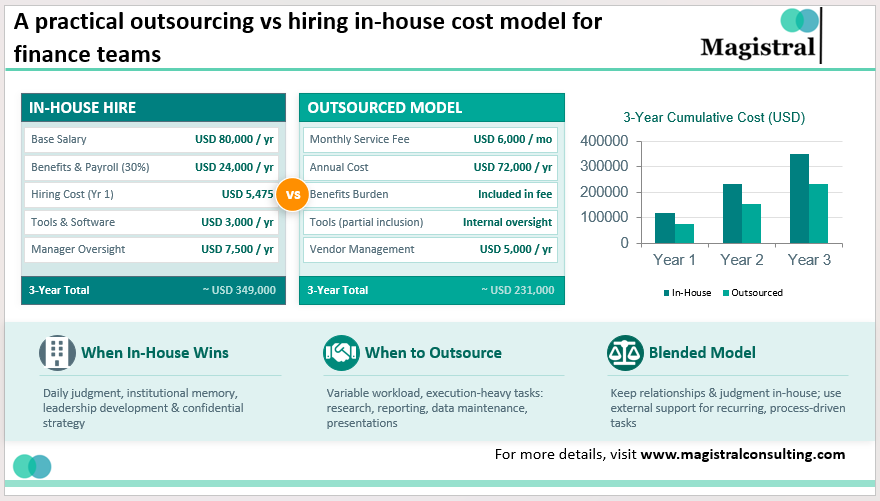
In outsourcing vs. hiring in-house, a useful three-year model should compare total cost, not visible cost. Finance leaders can build a simple side-by-side view that captures both cash cost and operational friction. reference
A practical outsourcing vs hiring in-house cost model for finance teams
Illustrative 3-year cost example | In-house hire | Outsourced support model |
Base annual labor or service cost | USD 80,000 salary | USD 6,000 per month = USD 72,000 per year |
Benefits and payroll burden | 20% of salary = USD 16,000 per year | Included in vendor fee |
Hiring cost in year one | USD 4,700 | Minimal compared with recruiting a full-time employee |
Tools, equipment, and software | USD 3,000 per year | Often partly included, plus internal oversight costs |
Manager oversight cost | USD 7,500 per year if a manager spends about 3 hours weekly at USD 50 per hour | USD 5,000 per year if oversight is lighter but still required |
Estimated 3-year total | About USD 290,200 before raises or attrition | About USD 231,000 before scope changes |
These figures are illustrative rather than universal, but they show the logic of a three-year model. In-house cost rises above salary once benefits, hiring expense, tools, and manager time are counted. Outsourcing is not automatically cheaper, yet it can produce a lower three-year total when workload is variable and the provider delivers reliable capacity without heavy rework.
The in-house cost stack
Begin by calculating annual salary. Add benefits, payroll taxes, recruiting cost, onboarding cost, technology cost, workspace rental, training, management cost, and anticipated raises. For specialized positions, also add recruiter cost and vacancy cost. In outsourcing vs hiring in-house, this helps reveal the true internal cost stack.
Here’s what a simplistic in-house three-year model might be expressed in words: annual salary increases yearly; benefits are above salary; recruiting happens first year; tools come annually; while lost productivity happens during ramp-up or replacement.
The outsourced cost stack
A cost stack for outsourcing begins with monthly or project-based fees. You must also calculate transition time, internal review time, communications time, and vendor management time. Models worth their salt should include a contingency budget. In outsourcing vs hiring in-house, these hidden review costs can materially change the decision.
Remember that the comparison between in-house services and outsourcing is an analytical framework, not a marketing buzzword. Even if the outsourcing fee is cheaper but the internal review costs twice as much, you could wipe out any savings. Even if the outsourcing fee is more expensive but the executive saves ten hours per week, you might have a stronger business case.
Example three-year comparison
A financial services role with a USD 80,000 salary can cost much more once benefits, hiring, software, hardware, and management time are added. Over three years, the full cost may reach nearly USD 290,000 before raises or turnover.
By comparison, outsourced support at USD 6,000 per month equals USD 216,000 over three years before oversight costs. This makes outsourcing vs hiring in-house easier to compare, especially when workload varies month to month.
When the in-house model wins
In-house hiring wins when the role needs daily judgment, institutional memory, leadership development, or deep integration with confidential strategy. It also works when utilization is consistently high, and the company can retain talent.
A blended model is often the most effective option: keep client relationships, negotiation, and sensitive judgment in-house, while using outside support for research, presentation production, recurring reporting, and other execution-heavy tasks.
When outsourcing vs hiring in-house delivers better business value
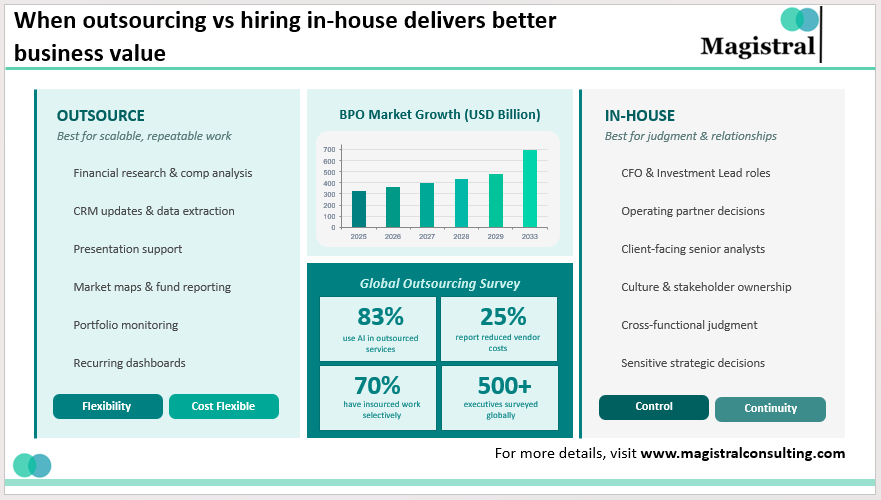
An optimal approach to operations is neither purely internal nor purely outsourced. Most organizations take an approach where the internal team retains control over decision-making while the outsourced partner handles speed, scalability, and repeatability of execution.
When outsourcing vs hiring in-house delivers better business value
Best-fit work for outsourcing
Outsourcing works well for financial research, comparable company analysis, CRM updates, data extraction, presentation support, market mapping, fund reporting, portfolio tracking, and dashboards. The business process outsourcing market was valued at USD 328.37 billion in 2025 and is expected to reach USD 695.77 billion by 2033.
Deloitte’s 2024 survey of 500 plus executives shows outsourcing is no longer just about cost. About 83% use AI in outsourced projects, 25% report lower costs or better service quality, and 70% have selectively brought some processes back in-house.
Best-fit work for in-house hiring
It makes sense to use in-house hiring when you need a job role that will influence the company culture, owns stakeholder relationship management, handles crucial decision-making or requires cross-functional judgment skills. A CFO, investment lead, operating partner, product owner or senior analyst working directly with clients ought to be near the company most times.
It is important to note that senior internal hires will be more effective when routine jobs can be handled by a reliable support team within an organization. This enables the company’s leadership to spend more time on making crucial decisions, managing stakeholders and doing valuable analysis rather than just report writing and process management.
Governance decides the outcome
The right decision in outsourcing vs hiring in-house depends on the company’s governance. It is wise to decide ahead of time about scope, turnaround time, quality, confidentiality requirements, review ownership and how escalation works.
A balanced three-year choice
A balanced choice in outsourcing vs hiring in-house takes into account what the business values most. Outsourcing brings flexibility, quicker access to talent and reduced fixed costs. However, hiring employees in-house helps organizations gain control, consistency and culture. They revisit the model regularly, compare actual cost against output, and adjust the mix as strategy changes.
Magistral’s Outsourcing Services
Magistral Consulting provides operations outsourcing support to private equity firms, venture capital funds, asset managers, lenders, and corporate finance teams. Its services include financial research, company profiling, financial modeling and valuation, due diligence support, portfolio reporting, CRM and data management, presentation support, outsourced CFO services, and preparation of fundraising materials such as pitch decks, CIMs, and PPMs. Magistral typically works as an extension of internal teams, helping firms improve scalability and execution capacity while allowing leadership teams to remain focused on investment decisions, client relationships, and strategic priorities.
About Magistral Consulting
Magistral Consulting has helped multiple funds and companies in outsourcing operations activities. It has service offerings for Private Equity, Venture Capital, Family Offices, Investment Banks, Asset Managers, Hedge Funds, Financial Consultants, Real Estate, REITs, RE funds, Corporates, and Portfolio companies. Its functional expertise is around Deal origination, Deal Execution, Due Diligence, Financial Modelling, Portfolio Management, and Equity Research
For setting up an appointment with a Magistral representative visit www.magistralconsulting.com/contact


Comments
Post a Comment