Investment Research Outsourcing in 2026: A Complete Guide
Faster markets, broader coverage, and increasingly thin margins have driven Investment research outsourcing from a tactical expense reduction to an operational strategy for investment banks, asset managers, hedge funds, private markets players, and family offices. This necessitates a requirement for greater sector expertise, clean models, speed, and research capacity to adapt to changing mandates. In addition, the entire asset/wealth management sector is scaling up its addressable market.
As per PwC projections, assets under management across the world will grow from $139 trillion in 2023 to $200 trillion by 2030. Even as margins continue to be squeezed, efficient operations have thus become even more important than before. On the other hand, Deloitte reports that the number of M&A transactions dealing with investment and wealth management organizations grew significantly in the first half of 2025 relative to 2024.
Why Investment Research Outsourcing Matters More in 2026
The case for this model is no longer just about labor arbitrage. In 2026, firms are using external research teams to expand coverage, shorten turnaround time, and free internal professionals to focus on idea generation, portfolio decisions, and client conversations. reference
Why Investment Research Outsourcing Matters More in 2026
Margin pressure is forcing smarter operating models
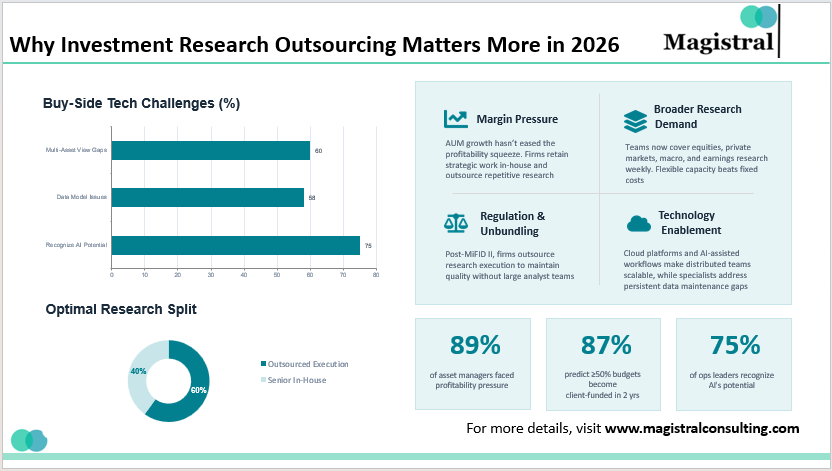
Asset growth sounds impressive on paper, but it has not removed the squeeze on profitability. PwC reports that 89% of asset managers faced profitability pressure over the past five years, even while industry AUM continues to climb. That creates a very practical question for leadership teams: where should scarce senior time really go? For many firms, the answer is to keep high judgment work in-house and move repeatable research execution to specialists.
Research demand has become broader and more continuous
A single research team can nowadays encompass listed equities, private company coverage, thematic screenings, macroeconomic analysis, earnings research, valuations, and competitor research all in a single week. That would be difficult to achieve without outside support. It has therefore become common practice to supplement a firm’s in-house analysts with outsourced capabilities for channel checks, model upgrades, screenings, and presentations. Similar trends hold for related businesses like private equity and venture capital, which also have to cope with flexible demands.
Regulation and unbundling changed the economics of research
The discussion around research budget allocation has become more urgent with MiFID II and the resulting developments. Substantive Research discovered that 87% of survey respondents from the buy side expected at least half of the research budget to be covered by clients within the next two years. It is relevant because the focus has been shifting to who provides research, how it should be funded, and which processes absolutely require high-priced senior analysts. Investment research outsourcing responds to these changes by allowing firms to secure research quality while not supporting an oversized analyst pool.
Technology made distributed research teams more workable
A decade back, managers were concerned about delays caused by external teams. But things have evolved since then. Cloud computing, collaboration platforms, research management tools, and AI-assisted writing tools have all been game changers in this context. The latest report published by SimCorp for 2025 has revealed that while 75% of operations leaders see potential in AI, almost 58% of them are facing challenges with managing data models, and 60% lack the ability to have an integrated view of multiple assets.
How Investment Research Outsourcing works across the investment lifecycle
This process will work best when it stops being considered an overflow activity to be outsourced and is instead viewed as an integral part of the firm’s operating model. The best relationships will specify what should be outsourced, what should remain in-house, and how the transfer of quality occurs along the way.
Origination and idea screening
At this level of the sales and trading funnel, investment research outsourcing partners can create long candidate lists, draw sector maps, keep tabs on fundraising trends, create peer groups, and produce initial company write-ups. Investment research outsourcing is especially beneficial for those in the investment banking business, as it means more efficient utilization of their senior bankers, as they have more time to analyze instead of collecting data. Good outsourcers do not replace judgment; they make better use of it.
What gets outsourced most often at this stage- Tasks that can be outsourced are sector maps, target screens, potential investors lists, earnings recaps, transcript analysis, and management meeting recaps.
Diligence and deep dive analysis
Whereas names that pass through the first filter face more thorough investigation. Usually, in such cases, investment research outsourcing includes such components as financial statement spreading, sensitivity analysis, customer and competitor mapping, industry sizing, transcript review, and scenario modeling improvement. Here, connections with the work on DCF are particularly significant, since valuation research requires strict adherence to the principle of model hygiene prior to any review by an investment committee.
Why does this stage benefit from external support
It is not always a nice process, but diligence windows tend to close very fast, while managers will always expect quality analysis. Investment research outsourcing allows firms to expand their focus without losing the speed of execution. This is particularly important in markets characterized by information fragmentation, when there is a need to extract insights from various data.
Portfolio monitoring and coverage maintenance
After the investment, there comes no relief for the firm that still requires regular reporting and updates, including quarterlies, KPIs, competitive environment changes, macroeconomic overlay, as well as new investment memos. For this reason, some buy-side players make use of investment research outsourcing not once but twice. Besides, portfolio reporting for multiple funds requires standardization of the whole process.
Marketing and investor communication support
Research does not live only inside an IC memo. It also shapes pitchbooks, manager commentary, strategy notes, and fundraising materials. Deloitte’s 2026 investment management outlook points to continued product expansion, private market access, and deal activity as firms compete for growth, which means analytical content increasingly supports distribution as much as investment teams.
Risks, controls, and future direction of Investment Research Outsourcing
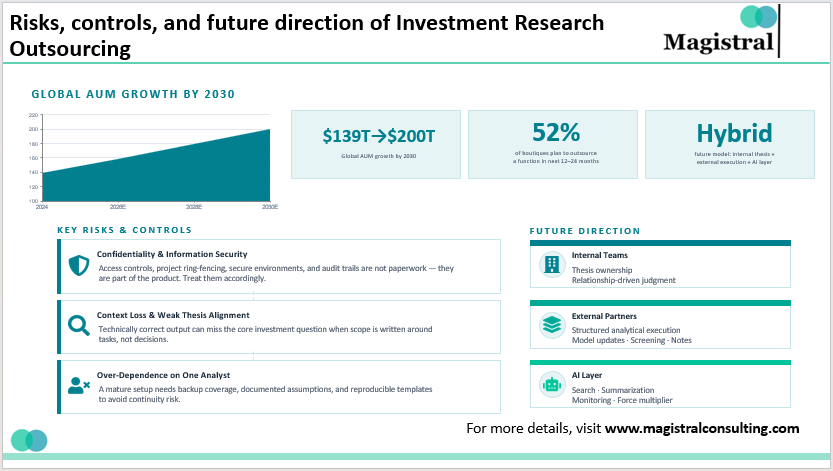
Global assets under management are expected to grow from $139 trillion to $200 trillion by 2030, and profitability will remain challenging; thus, lean operations have never been as important as they are now. Although the approach offers significant benefits, it brings risks as well. Luckily, in most cases, all risks can be mitigated with proper planning of the workflow. reference
Risks, controls, and future direction of Investment Research Outsourcing
Confidentiality and information security
Many research assignments involve dealing with unpublished management opinions, internal finances, and transactions. Thus, access controls, project ring fencing, safe environments, and audit trails are important. Security documentation cannot be viewed simply as an additional burden – it is part of the product.
Context loss and weak thesis alignment
An external team may produce correct results without answering the core business question. Such a situation arises due to the fact that the scope focuses on tasks and does not define the key decision context, the target audience, the output format, and the top three issues that need answers.
Overdependence on one person or one team
A mature system requires redundancy, recorded assumptions, and replicable templates. The problem is that everything falls apart as soon as the lead analyst is no longer available. This is particularly significant when the organization has other concurrent requirements, such as capital raising, portfolio management, and quarterly investor communications.
The future is blended, not fully external
Investment research outsourcing is going to move towards being a combination of the internal and external systems. Internally, the organizations will retain thesis ownership and relationship-based judgment capabilities. Externally, the organizations will focus on the structurally analytically oriented tasks. In between all this, artificial intelligence will be used as a force multiplier. This is in line with how market trends indicate that things should move: Universal Investment found in its 2025 boutique asset manager survey that 52% of firms would consider outsourcing at least one business function within the next 12 to 24 months, and SimCorp’s operations leaders still require AI expertise in process improvement.
How Magistral Supports Investment Research Outsourcing
The firms that gain the most from this model usually want more than generic analyst capacity. They want domain familiarity, flexible staffing, clean deliverables, and processes that fit live investment workflows. That is where a specialist partner can make a difference with investment research outsourcing.
Sector-aligned research support
Magistral’s broader body of work across equity research, financial modeling, fund support, deal execution, and investment operations suggests a model built for financial services rather than generalist outsourcing. That matters because sector language, valuation nuance, and timeline discipline are very different in this field.
Support across multiple use cases
A practical engagement can include company profiles, industry research, valuation models, earnings notes, portfolio monitoring, pitch materials, and competitor mapping. For clients that also operate across real estate financial modeling or adjacent private market mandates, cross-functional familiarity can reduce handoff friction.
Scalable capacity without a fixed bench burden
That matters in an environment where global AUM is growing, product complexity is increasing, and operating leverage is still hard to achieve. When internal teams stay lean, but mandate flow remains unpredictable, external support gives firms room to move without rebuilding headcount every cycle. PwC’s industry outlook and Deloitte’s 2026 investment management commentary both point to a future where growth and efficiency have to coexist.
Better research workflows, not just lower cost
The strongest reason to explore this model is not the cheaper output. It is a better-organized output. A well-run external research setup can improve turnaround time, standardization, coverage depth, and internal focus. If that sounds like the real objective, then investment research outsourcing is not a temporary workaround. It is a more deliberate way to build research capacity for 2026.
About Magistral Consulting
Magistral Consulting has helped multiple funds and companies in outsourcing operations activities. It has service offerings for Private Equity, Venture Capital, Family Offices, Investment Banks, Asset Managers, Hedge Funds, Financial Consultants, Real Estate, REITs, RE funds, Corporates, and Portfolio companies. Its functional expertise is around Deal origination, Deal Execution, Due Diligence, Financial Modelling, Portfolio Management, and Equity Research
For setting up an appointment with a Magistral representative visit www.magistralconsulting.com/contact


Comments
Post a Comment