Fund Administration and Accounting: A Strategic Guide
As the size and intricacy of the private markets grow, shifts have elevated fund administration and accounting from a purely back-office function to an essential part of the investment operation. In this regard, the steady expansion of the global fund administration services market can be considered as an indication. Specifically, according to the latest projections, the market will rise from about $5.2 billion in 2019 to $17.4 billion in 2034, recording a CAGR of 8.1% during this period. reference
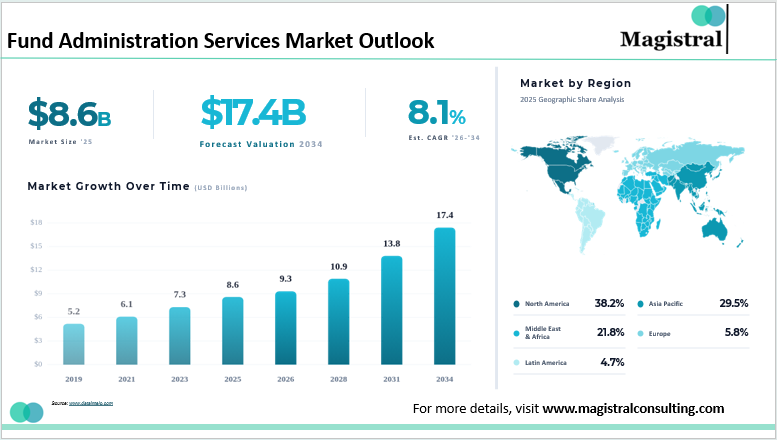
Fund Administration Services Market Outlook
However, behind all this growth, there is an intricate network that enables all this to be accomplished. Indeed, there are many aspects that require the involvement of fund administration and accounting professionals.
Moreover, over $60 trillion in global assets are being managed using structures supported by the work of fund administration and accounting specialists.
The Evolution of Fund Administration and Accounting
Changes in fund administration and accounting can be attributed to a change in the approach of how companies in the private markets conduct their operations due to increasing competition and reliance on technology. The scaling up of firms alongside a globalization of investors has created the need for a more efficient operation process.
This involves the ability to exercise greater control and make decisions quickly. Additionally, there should be alignment of objectives between the fund manager and the investor. Thus, fund administration and accounting have come to play an essential role in this scenario.
From Back-Office Function to Strategic Enabler
Historically, fund administration and accounting were regarded as support functions concerned only with meeting compliance, keeping records, and conducting periodic financial reporting. Fund administrators’ and accountants’ roles were limited to ensuring that the required regulations were complied with and financial statements were prepared accurately and delivered on schedule for the benefit of the investors. Nowadays, due to the growth and complexity of the private markets, both functions have become strategic enablers that help establish an investor’s confidence and positively affect overall fund performance.
There are several reasons that contribute to this transformation of the functions performed by fund administrators and accountants. Firstly, there is increasing regulation with higher demands regarding the quality and promptness of reports, together with the growing requests of the investors for transparency and more information about fund performance. Secondly, the requirement for the availability of information in real time has become a crucial necessity. Hence, it has become necessary for firms to move from routine reporting towards more flexible approaches to processing data.
Increasing Complexity Across Private Markets
The complexities of the market have grown greatly. Global deal value in terms of private equity transactions has reached the $2 trillion mark, despite a fall in deal flow, pointing towards an increase in deal size.
Moreover, the holding period now extends to around six years, adding to the need for valuations that have to be done for a longer duration and complicated distributions.
Technology and Market Transformation in Fund Administration
Fund administration and accounting are changing in response to market growth, combined with technology advancements. With the growing complexities in fund architecture and investor demands, firms must adjust their operations through more efficient processes that leverage new technology.
This change brings about new dynamics with regard to data flow within organizations and how they process insights, as well as enabling firms to cater to regulatory and client demands. With all these factors considered, it is clear that the current evolution in fund administration and accounting is being driven by technology advancements.
Growth of the Fund Administration Ecosystem
The fund administration industry itself is expanding rapidly, with the global market projected to reach around $68 billion by 2027. The rapid growth is fueled by the increased need for specialization within the financial sphere due to the growing complexity of operations carried out and regulatory compliance requirements. At the same time, the trend indicates a growing tendency to outsource services as companies aim at maintaining high performance through automation.
Finally, the fund accounting software market does not stand still as well and now exceeds the size of $20 billion. The fast growth can be explained by the ever-increasing need for automation and sophisticated technical support which can help to cope with vast amounts of information and complex operations.
The Role of Automation, Data, and AI
The Fund Administration & Accounting industry is being transformed by technology due to increasing efficiency and capabilities. Automation is cutting down on mistakes made and speeding up the reporting process. At the same time, cloud platforms allow for real-time access to the fund’s data.
The introduction of artificial intelligence is also allowing for some more advanced activities like identifying anomalies in data, predicting future events, and recognizing patterns. This means that fund administrators will be able to recognize discrepancies in their calculations sooner and better predict future cash flow trends. Thus, fund management is slowly changing from a process of retrospective reporting to a real-time process.
The Strategic Importance of Fund Administration and Accounting
In the case when the capital markets have become very selective when it comes to resource allocation, operational excellence is becoming the key difference between the success and failure of fund managers. Indeed, in line with that, there is an overall trend towards the development of the market of finance and accounting outsourcing, where the size of it is expected to reach almost $95 billion by 2031 with an annual increase of 7.78%. In such conditions, reporting quality will affect investors’ decisions directly, while the efficiency of the process itself will have an impact on both the operation and performance of the funds.
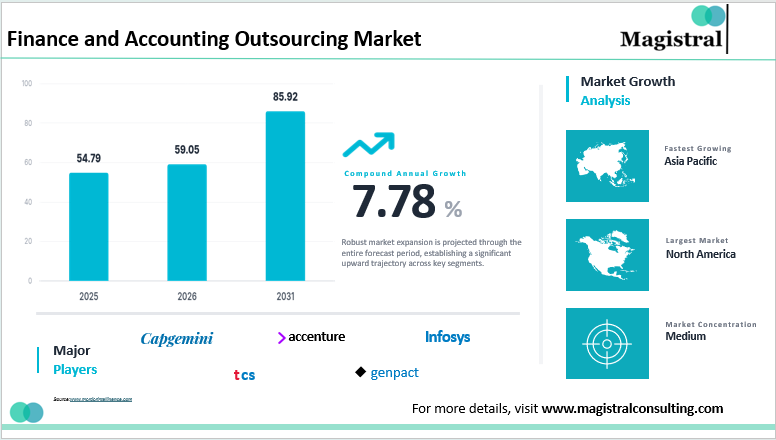
Finance and Accounting Outsourcing Market
Given that investors have become very cautious and use more data-driven approaches to decision-making, the relevance of high-quality fund administration and accounting is increasing. It is not a secret that a well-developed administration has a huge impact on fundraising processes, and, consequently, on future partnerships between the company and its stakeholders. In these conditions, any small improvement in reporting accuracy and efficiency will bring a substantial advantage for the fund manager.
Future Outlook
The future of fund administration and accounting will be driven by scale, standardization, and smarter use of data. Alternative investments are set to rise further in popularity, with private market assets expected to surpass the $10 trillion mark by 2030. Meanwhile, regulatory pressures will become more rigorous and standardized, especially in relation to increased reporting needs. In response, fund administrators will have to adapt their systems to keep pace with changing demands and ensure compliance.
Technology will be the key factor here, as the utilization of AI and analytics within finance is forecasted to increase at over 25% CAGR until 2030. In light of changing investor expectations for increased transparency and real-time access, fund administration and accounting is bound to take on the form of a control centre fueled by data analytics.
How Magistral Supports Fund Administration and Accounting
In an environment where accuracy, transparency, and speed are critical, Magistral supports fund managers by strengthening their fund administration and accounting functions through structured, scalable, and insight-driven solutions. The approach focuses on improving financial reporting quality, ensuring compliance, and streamlining operational workflows to handle increasing complexity across fund structures. By combining domain expertise with process efficiency, Magistral enables firms to maintain tighter control over fund operations while meeting evolving investor and regulatory expectations.
Magistral’s support includes:
Fund accounting and financial reporting aligned with industry standards
NAV calculations and portfolio valuation support
Waterfall modeling and distribution analysis
Investor reporting and capital account management
Reconciliation, audit support, and compliance assistance
Financial data management and reporting process optimization
Automation support to improve accuracy and reduce manual effort
This integrated approach ensures that fund managers can operate with greater efficiency and confidence, while focusing on core investment activities.
About Magistral Consulting
Magistral Consulting has helped multiple funds and companies in outsourcing operations activities. It has service offerings for Private Equity, Venture Capital, Family Offices, Investment Banks, Asset Managers, Hedge Funds, Financial Consultants, Real Estate, REITs, RE funds, Corporates, and Portfolio companies. Its functional expertise is around Deal origination, Deal Execution, Due Diligence, Financial Modelling, Portfolio Management, and Equity Research
For setting up an appointment with a Magistral representative visit www.magistralconsulting.com/contact


Comments
Post a Comment