10 Investor Pitch Deck Mistakes Founders Must Avoid in 2026
A pitch deck is often the first meaningful interaction between a startup and a potential investor. In many cases, investors decide within a few minutes whether they want to continue the conversation. That makes the quality of pitch decks far more important than many founders initially realize.
In 2026, AI has become central to venture capital allocation, with investors directing a growing share of funding toward AI-driven businesses and infrastructure. As funding activity intensifies, venture capital firms and private investors are evaluating significantly more opportunities while operating within a more disciplined investment environment. At the same time, AI-powered tools have made pitch deck creation faster and more accessible, resulting in investors reviewing hundreds of polished presentations every month.
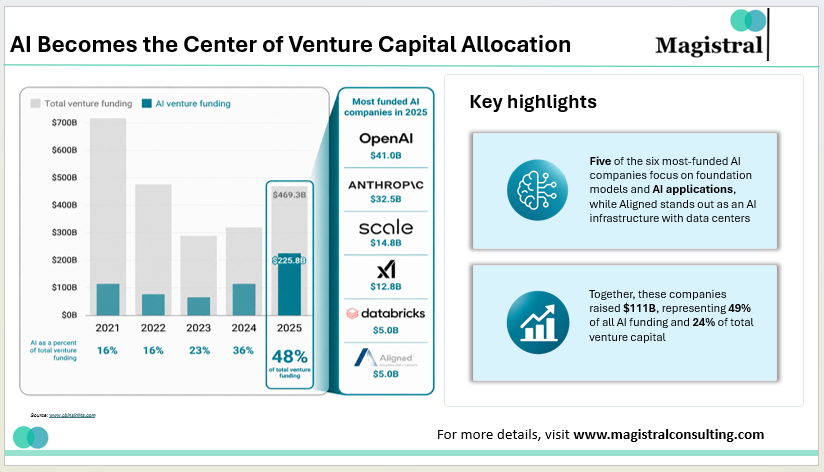
AI Becomes the Center of Venture Capital Allocation
This shift has changed investor expectations. Design quality alone is no longer enough to differentiate a company. Investors are placing greater emphasis on clarity of vision, market understanding, scalability, execution capability, and the ability to communicate a compelling growth narrative.
Many investor pitch decks fail not because the underlying business lacks potential, but because the presentation does not clearly convey the opportunity, competitive positioning, or strategic value. In an increasingly crowded fundraising landscape, avoiding common pitch deck mistakes has become critical to securing investor attention and improving fundraising outcomes.
Why Investor Pitch Decks Matter More Than Ever
Fundraising momentum has accelerated significantly in 2026, driven by record-setting mega-deals and increasing capital concentration across venture markets. While overall deal activity has improved, investors remain highly selective, focusing on larger investments in companies with strong market positioning, scalable business models, and clear execution capabilities.
According to recent venture capital data, a substantial share of total funding is now concentrated within a limited number of large transactions, reflecting investor preference for high-conviction opportunities and mature growth stories. This has made competition for investor attention even more intense for emerging startups seeking capital. reference
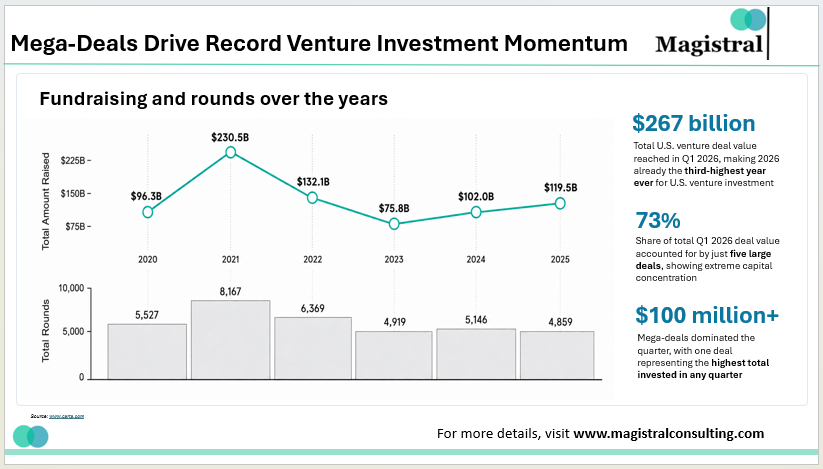
Mega-Deals Drive Record Venture Investment Momentum
In this environment, the investor pitch deck has become one of the most critical fundraising tools for founders. A strong pitch deck demonstrates far more than product quality. It reflects how clearly a founder understands the market opportunity, competitive landscape, growth strategy, capital requirements, and long-term business scalability.
Mistake 1: Failing to Clearly Explain the Problem
One of the most common mistakes in investor pitch decks is presenting vague or generic problem statements.
Investors need to quickly understand what problem exists, who experiences it, and why solving it creates a scalable business opportunity. Many founders describe broad industry inefficiencies without explaining the urgency or economic impact of the issue.
A weak problem statement makes even strong products appear commercially weak. Investors are more likely to engage with businesses that clearly define customer pain points and explain why existing solutions are insufficient.
Mistake 2: Overcomplicating the Solution
Many founders try to explain every feature of their product rather than communicating the core value proposition clearly.
An investor pitch deck should simplify complexity rather than overwhelm investors with technical details. Investors are not evaluating whether they can personally operate the product. They are evaluating whether the solution addresses a meaningful market problem in a scalable and defensible way.
Overly technical slides, excessive product screenshots, and complicated explanations often weaken the overall narrative. The strongest pitch decks communicate the solution clearly, quickly, and with strategic focus.
Mistake 3: Presenting Unrealistic Market Size Estimates
Inflated market opportunity claims are one of the fastest ways to lose investor credibility.
Many investor pitch decks use extremely large Total Addressable Market figures without narrowing them to realistic customer segments or geographic opportunities. Investors increasingly expect founders to distinguish between the total market opportunity and the portion of the market they can realistically capture.
In 2026, investors are placing far greater importance on execution realism rather than headline market numbers. A smaller but clearly achievable market opportunity is often more attractive than unrealistic billion-dollar projections without supporting logic.
Mistake 4: Weak Competitive Analysis
Some founders still claim they have no competitors, which immediately creates skepticism among investors.
Every business competes with something, whether it is direct competitors, alternative workflows, internal processes, or customer inertia. Investors expect founders to understand the competitive landscape deeply.
Strong investor pitch decks explain how the company differentiates itself through pricing, technology, operational advantages, customer experience, or scalability. This has become especially important in AI-driven markets where competitive barriers can shift rapidly.
A thoughtful competitive analysis signals strategic maturity and market awareness.
Mistake 5: Lack of Financial Discipline
Financial projections are often one of the weakest sections in investor pitch decks.
Many founders present aggressive revenue forecasts without clearly explaining the assumptions behind customer acquisition, pricing, margins, or growth rates. Investors understand that early-stage projections are rarely precise, but they still expect logical thinking and operational discipline.
In 2026, investors are paying closer attention to burn efficiency, runway visibility, customer acquisition economics, and realistic profitability timelines. A strong financial section demonstrates that founders understand not only growth opportunities but also operational realities.
Mistake 6: Ignoring Existing Traction
Many investor pitch decks spend too much time discussing future potential while failing to highlight current traction.
Investors want evidence that customers are already responding positively to the product or service. Depending on the business stage, traction may include revenue growth, customer retention, enterprise partnerships, pilot programs, user engagement, or recurring contracts.
Even modest traction with strong momentum can significantly strengthen investor confidence. A pitch deck without meaningful traction indicators often feels speculative, regardless of how strong the market opportunity appears.
Mistake 7: Poor Storytelling Structure
A pitch deck is not simply a collection of slides. It is an investment story.
One of the most common mistakes in investor pitch decks is presenting information without a logical flow. Investors should be guided naturally from the problem to the solution, the market opportunity, the business model, traction, the financial outlook, and the funding strategy.
When slides feel disconnected or repetitive, investors struggle to understand the business narrative clearly. Strong storytelling creates momentum throughout the presentation and helps investors retain key information more effectively.
Mistake 8: Prioritizing Design Over Clarity
Visual presentation matters, but excessive design can weaken communication.
Many founders spend too much time on animations, graphics, and visual effects while neglecting message clarity. AI-powered design platforms have made polished pitch decks easier to create, so visual quality alone no longer effectively differentiates companies. The best investor pitch decks maintain clean formatting, concise messaging, consistent structure, and high readability. Investors typically prefer clarity over excessive visual complexity.
Mistake 9: Weak Team Positioning
Investors often evaluate the founding team as closely as the product itself.
However, many investor pitch decks fail to explain why the founders are uniquely positioned to execute the business successfully. Investors want to understand the team’s industry expertise, operational experience, technical strengths, and strategic advantages.
This becomes especially important in sectors such as AI, healthcare, fintech, and enterprise software, where execution complexity is high. A strong team slide strengthens investor confidence in the company’s long-term ability to navigate competitive and operational challenges.
Mistake 10: An Unclear Funding Ask
Many investor pitch decks mention the amount of capital being raised without explaining how the funds will be used strategically.
Investors want clarity around how additional funding will impact growth, product development, hiring, market expansion, or operational milestones. A vague funding ask often signals weak planning discipline.
Strong pitch decks clearly explain how the investment will accelerate the company’s next stage of growth and what measurable outcomes investors should expect from the capital deployment.
How Investor Expectations Are Evolving in 2026
Investor expectations around pitch decks are changing rapidly because of AI adoption and broader fundraising market shifts.
Since AI tools can now generate basic investor pitch decks quickly, investors are becoming more sensitive to generic messaging, templated narratives, and exaggerated claims. Founders can no longer rely on presentation quality alone to stand out.
Modern investors increasingly value authenticity, strategic clarity, realistic assumptions, and deep market understanding. They want to see evidence of disciplined execution rather than purely ambitious storytelling.
This shift is forcing founders to create investor pitch decks that are more focused, data-driven, and commercially grounded than ever before.
How Magistral Consulting Supports Pitch Deck Preparation
Magistral Consulting supports startups, private equity firms, venture capital funds, and investment professionals with investor pitch deck preparation through an AI + human analyst model that combines research, financial analysis, storytelling, and presentation support.
Investor-Focused Pitch Deck Structuring
Magistral helps founders and investment teams structure pitch decks around investor expectations, ensuring the presentation clearly communicates the problem, solution, market opportunity, business model, competitive positioning, traction, and funding strategy.
Market Research and Industry Insights
The firm supports pitch deck development with detailed market research, industry analysis, competitor benchmarking, and market sizing to strengthen the commercial credibility of investor presentations.
Financial Modeling and Forecasting
Magistral assists with financial projections, revenue modeling, valuation analysis, and forecasting to ensure pitch deck assumptions remain realistic, data-backed, and investor-ready.
AI + Human Research Support
Using an AI + human execution model, Magistral combines AI-assisted research workflows with analyst validation to accelerate information gathering while maintaining strategic and commercial accuracy.
Design and Presentation Support
Magistral also supports visual structuring, slide flow optimization, and presentation refinement to improve clarity, readability, and investor engagement across pitch decks.
Fundraising and Investment Narrative Development
The firm helps businesses develop compelling investment narratives that align with investor priorities, market conditions, and fundraising objectives while maintaining clarity and strategic focus throughout the deck.
About Magistral Consulting
Magistral Consulting has helped multiple funds and companies in outsourcing operations activities. It has service offerings for Private Equity, Venture Capital, Family Offices, Investment Banks, Asset Managers, Hedge Funds, Financial Consultants, Real Estate, REITs, RE funds, Corporates, and Portfolio companies. Its functional expertise is around Deal origination, Deal Execution, Due Diligence, Financial Modelling, Portfolio Management, and Equity Research
For setting up an appointment with a Magistral representative visit www.magistralconsulting.com/contact


Comments
Post a Comment