Pitchbook Support Market Size, Growth, and 2026 Trends
When capital becomes more selective, a pitchbook shifts from being just a presentation to a critical deal tool, which is why Pitchbook Support has become more important in 2026. Investors now expect sharper market sizing, clearer competitor analysis, stronger valuation logic, and faster updates between meetings. At the same time, private markets are expanding and becoming more data-driven, with McKinsey estimating the industry at around $22 trillion. In this environment, firms that can produce accurate, high-quality, and timely deal materials gain a clear competitive advantage.
Pitchbook Support and The Market Size Behind It
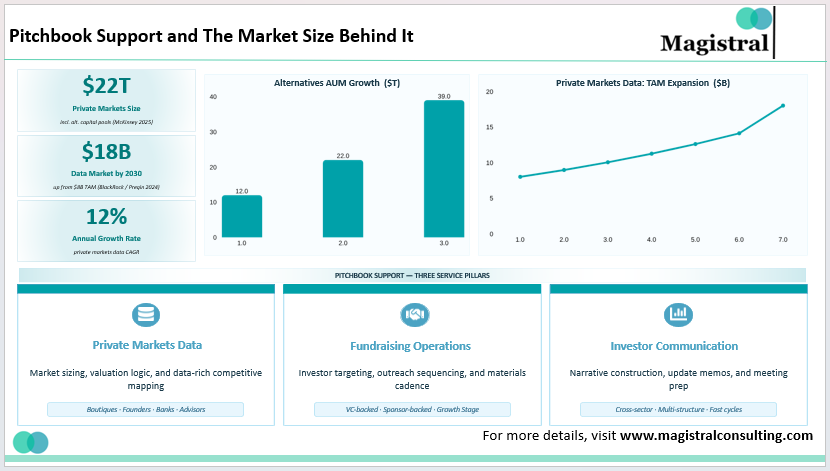
The Pitchbook Support service operates through three main areas, which include private markets data, fundraising operations, and investor communication activities. The value of systematic assistance increases when the deal environment grows and the complexity for organizations. reference
Pitchbook Support and The Market Size Behind It
Private Markets Data and Investment Ecosystem Growth
The market for Pitchbook Support is driven by the growth of private markets infrastructure. BlackRock estimates the private markets data segment at $8 billion, growing at 12% annually to reach $18 billion by 2030, while alternative AUM is projected to expand from $12 trillion in 2020 to $39 trillion by 2030. McKinsey values the broader private markets ecosystem at around $22 trillion in 2024, including nontraditional capital pools. As this ecosystem expands and diversifies, demand for Pitchbook Support continues to rise across founders, banks, and advisors.
Increasing Complexity in Investor Evaluation
Investors need to analyse multiple companies across different sectors while evaluating different transaction structures because the opportunity set has expanded. Teams now use market maps, buyer lists, and outreach logic together with deal materials to accomplish their goals. Fast-moving fundraising cycles require pitchbooks that need to present narrative content, numerical data, and investor targeting information in a specific sequence.
Expanding Demand Across Deal Participants
The demand for services extends beyond major banking institutions. The demand for services originates from boutique firms and founder-owned businesses, growth stage companies, and advisory firms that work with venture capital and sponsor-backed clients.
Pitchbook Support Growth Drivers and Emerging Trends
The Pitchbook Support system now experiences expansion because data complexity grows, investor expectations change, and advanced technologies, including artificial intelligence, begin to transform the system.
Pitchbook Support Growth Drivers and Emerging Trends
Expansion of Private Markets and Capital Flows
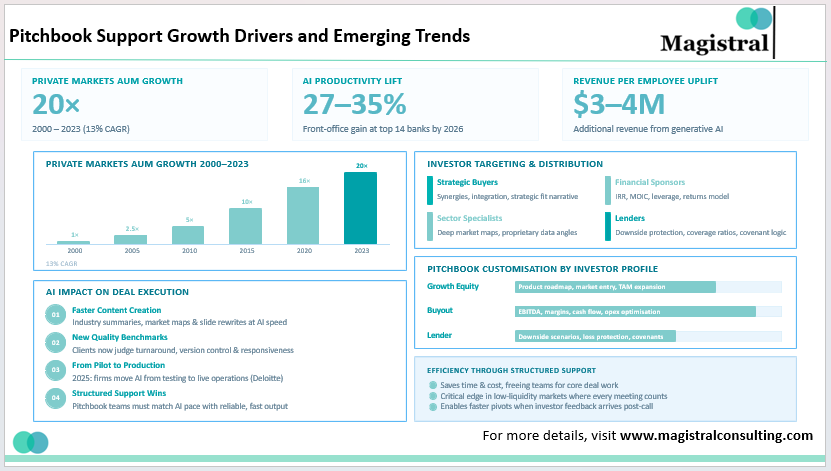
The Private Markets and Capital Flows show complete expansion. The long arc is clear. The McKinsey research shows that total AUM across private market asset classes increased almost 20-fold between 2000 and 2023 because of a 13% CAGR. The workflow system shows that Deloitte predicts generative AI will boost front office productivity for the 14 largest global investment banks between 27% and 35% by 2026, resulting in extra revenue of $3 million to $4 million for each employee. The system requires Pitchbook Support to match the speed of AI-enabled research and the quickness of new revisions, and the development of specific investor communications. Market expansion, together with execution speed improvement, drives business growth according to the company’s operational model.
Impact of AI on Deal Execution and Content Creation
The business operations of deal execution and content production operate under AI influences. The introduction of AI tools changed the benchmarks because they helped bankers and advisors create summaries of industries, produce market maps, and rewrite slide narratives at a faster pace. Clients no longer judge only the final deck. The evaluation process includes turnaround time, version control, and assessment of team performance in handling new requests after a partner call. The 2025 outlook from Deloitte shows that businesses will progress from testing their systems to using them for actual operations, particularly in areas where they can enhance operational efficiency and increase their financial results.
Rising Importance of Investor Targeting and Distribution
The process of targeting specific investors for distribution work has become more important than ever before. The investor pitchbook needs to present a polished appearance which should match the expectations of its intended investor audience. Support functions now work together with investor list development, CRM maintenance activities, and data-driven market segmentation research. The same private equity materials require different presentation methods to address strategic buyers, financial sponsors, and sector specialists.
Customizing Pitch Books for Different Investor Profiles
A growth equity investor may value product development and market entry as important factors. A buyout investor will require more detailed analysis of cash flow, operational expenses, and profit margins. A lender requires protection against potential losses. The support function needs to foresee all upcoming changes that will occur before the scheduled meeting begins.
Efficiency Gains Through Structured Support Models
Magistral’s earlier note on the topic highlighted a simple point that still holds up: support services save time and cost while letting teams focus on core work. The time-saving benefits gain business importance because of the market conditions, which show inconsistent liquidity and require essential meetings to succeed.
Pitchbook Support and Recent Market Trends
Active funding markets exist currently, but funders possess strict criteria that require exact location details about projects.
Concentration of Capital and Deal Activity
The distribution of funds, together with business deals within the market, remains concentrated in specific areas. The first quarter of 2026 recorded 267.2 billion dollars of deal activity and 347.3 billion dollars of business departures, but the total value decreased significantly when all major transactions were removed because of the high concentration of major deals. Two-thirds of the deal value originated from AI, which created the need for improved Pitchbook Support that relied on actual data.
Sector-Specific Narratives Matter More
Companies need to develop specific stories about their business sectors because they currently invest only in a limited number of themes, which include artificial intelligence. The teams use their pitchbooks to create specific messages, which they measure against established standards.
Liquidity Pressures Continue
The market continues to experience liquidity challenges while funding from businesses remains stable at low levels. The pitchbook needs to include strategies for business exits, which should include realistic timeframes and valuation methods, together with growth stories.
How Magistral Approaches Pitchbook Support?
The Pitchbook Support system operates most effectively when research activities and messaging work together with execution work instead of being conducted in separate departments.
Building the deck around investor questions
The deck construction process starts with investor inquiry identification. Strong decks anticipate investor concerns. The section establishes a logical connection between market opportunity assessment and business model development, which leads to traction achievement and the valuation process through fundraising activities and outreach work.
Combining research with model discipline
Research activities must be combined with model-based requirements. A compelling story must be backed by solid numbers. The combination of DCF and comparable analysis valuation methods establishes credibility, which helps build investor trust. The process of creating revisions needs to be completed through fast turnaround methods.
Turning around revisions quickly
The nature of fundraising activities remains in constant movement. The support team requires efficient tracking methods because every investor meeting generates additional support needs, which should be handled through fast modifications instead of fixed presentations.
Keeping the close natural
The investor closing process should maintain its authentic character. Selective capital allocation combined with high organizational expectations enables Pitchbook Support to deliver structured assistance, which transforms data into a compelling narrative that creates a powerful initial impact.
About Magistral Consulting
Magistral Consulting has helped multiple funds and companies in outsourcing operations activities. It has service offerings for Private Equity, Venture Capital, Family Offices, Investment Banks, Asset Managers, Hedge Funds, Financial Consultants, Real Estate, REITs, RE funds, Corporates, and Portfolio companies. Its functional expertise is around Deal origination, Deal Execution, Due Diligence, Financial Modelling, Portfolio Management, and Equity Research
For setting up an appointment with a Magistral representative visit www.magistralconsulting.com/contact


Comments
Post a Comment