Optimizing Deal Execution for Faster Closures and Higher Returns
Deal execution is now characterized by measurable aspects of deal-making speed and efficiency as well as capital deployment results instead of merely deal completion processes. According to Bain & Company, top-quartile private equity firms achieve deal completion 20-30% faster than median-quartile firms. This means faster access to competitive deal flow. On the other hand, McKinsey & Company found that deal execution frameworks can increase accuracy in decision-making processes by as much as 30%, hence reducing mis-pricing risks in high-multiple deal-making. With private equity dry powder now above $3 trillion globally, as Preqin found out, efficient execution is now a quantifier for deal-making differentiation.
Deal execution now affects deal-making entry prices as well as deal-making certainty. In competitive deal-making processes such as auctions, sellers now prefer deal makers whose execution is as competitive as their prices. Thus, it is no longer merely a deal-making phase but a quantifier for deal-making results as well as risk mitigation and deal efficiency.
Deal Execution and Time-to-Close Metrics
It can now be quantified and measured based on deal-making efficiency as well as deal-making results.
Deal Execution and Time-to-Close Metrics
Compression of deal timelines
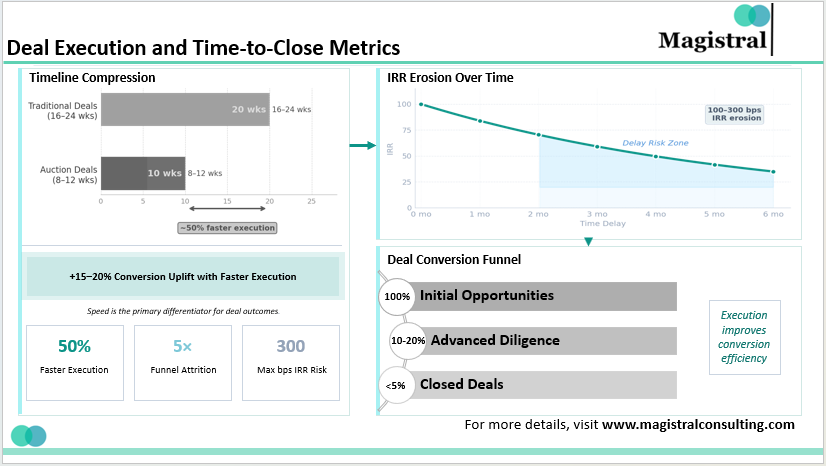
Average deal timelines for private equity deal-making have compressed considerably in competitive deal-making processes. According to Bain & Company, average deal timelines for auction-driven deal-making are now between 8-12 weeks as opposed to 4-6 months in less competitive deal-making processes. Faster deal makers have a significant advantage in acquiring high-quality deal flow, especially in proprietary or semi-competitive deal-making processes.
Impact of Delays on IRR
This has a direct mathematical impact on the returns. A 3–6-month delay in the deployment of capital can cause the returns to drop by 100-300 basis points depending on the assumption used in the calculation of the holding periods.
Parallel execution efficiency gains
Firms employing parallel execution models benefit from a 20-25% reduction in execution cycle. This is because the financial diligence, legal review, and financing processes occur simultaneously.
Conversion rates across the deal funnel
Industry benchmarks show that only 10-20% of the initial opportunities advance to the advanced diligence stage. Only fewer than 5% of the opportunities advance to the deal completion stage. The structured execution model improves the conversion rates.
Deal Execution and Capital Deployment Efficiency
It has a direct impact on the efficiency of the capital deployment and the returns on the investment.
Deal Execution and Capital Deployment Efficiency
Dry powder pressure and deployment speed
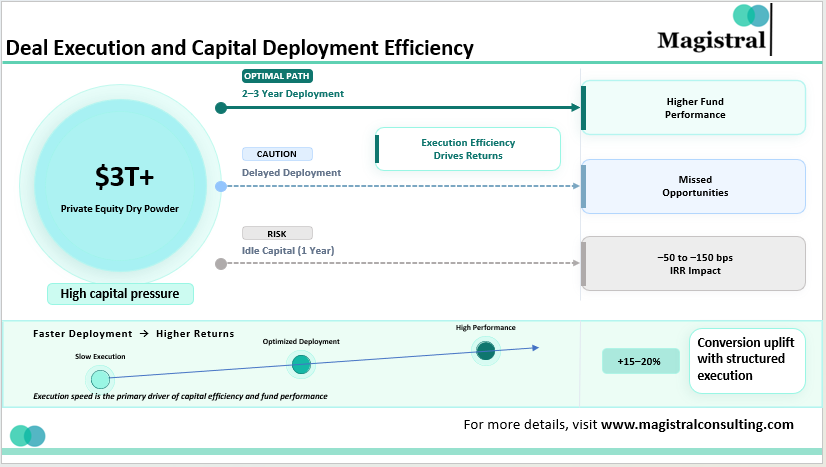
With the dry powder in the private equity industry standing at more than $3 trillion globally, the pressure on the private equity firms to deploy the dry powder efficiently has increased. Firms taking longer times to deploy the dry powder may be missing out on good investment opportunities. The dry powder of the peers may be deployed efficiently.
Deployment speed and fund performance
Funds taking 2-3 years to deploy the dry powder tend to perform better compared to the peers taking longer times. This enables the fund managers to create shareholder value early.
Idle capital impact
One year of idle capital can cause the returns to drop by 50-150 basis points depending on the conditions. This makes the efficiency of the execution critical in the private equity industry.
Pipeline conversion efficiency
Firms with structured execution processes achieve a 15-20% uplift in deal conversion rates due to better prioritization, speed, and coordination.
Deal Execution and Risk Quantification
It is closely related to quantified risk results, especially with high-value and high-contested deals.
Valuation risk and execution accuracy
Valuation multiples are high in various industries. This means that overpaying is a potential risk. McKinsey points out that an incorrect calculation by 1-2 times the EBITDA multiple can have major implications. A structured execution process eliminates this risk by improving validation, cross-checks, and accuracy.
Error reduction through standardization
Standardized execution processes achieve a 20-30% reduction in operational errors, especially with financial modelling, documentation, and compliance. This improves deal quality and enhances investors’ confidence.
Regulatory and compliance risk
Cross-border deals now account for an increasing proportion of all private equity transactions. This means that regulatory complexity is an added risk. A structured execution process eliminates delays due to compliance issues by improving documentation and approvals while adhering to regulatory requirements.
Diligence to execution integration
Firms that directly incorporate diligence results into their execution process achieve over a 20% reduction in post-deal surprises. This aligns investment and execution decisions.
Deal Execution and Technology-Driven Efficiency
Technology is driving improvements to deal execution speed, accuracy, and coordination.
Digital Deal Room Adoption
More than 90% of all private equity firms have now adopted virtual data room technology. This has reduced document processing times and made information sharing easier due to geographical dispersion.
Automation-driven efficiency gains
Automation achieves a 25-40% reduction in manual work effort required to execute deal-related processes, especially with data aggregation, reporting, and documentation.
Real-time execution tracking
Real-time execution tracking helps firms improve execution efficiency by 15-25 percent by reducing execution delays.
Analytics-enabled decision-making
The application of data-driven execution models helps firms improve decision-making efficiency by 20-30 percent.
Deal Execution and Value Creation Linkage
The importance of execution has increased in terms of the rate at which value creation initiatives begin.
Speed to value creation
The ability of firms to execute from deal execution to control within 30-60 days helps in faster realization of value creation initiatives.
Operational value contribution
The contribution of operational value creation has increased in recent private equity transactions, according to PwC.
Early identification of value drivers
The application of execution frameworks helps firms identify value creation early, thus improving returns.
Post-deal performance tracking
The application of performance tracking from the beginning helps firms improve efficiency in tracking performance by more than 25 percent.
Deal Execution and Competitive Performance Gap
The difference in execution efficiency has increased in terms of being a differentiator between high-performing firms and average firms.
Speed advantage of top-quartile firms
The application of execution frameworks by top private equity firms helps in faster execution, which is 20-30 percent faster compared to the rest of the firms.
Consistency in execution outcomes
The application of execution frameworks helps firms improve consistency in execution outcomes.
Investor Perception and Fundraising Impact
Strong execution track records boost LP confidence, thereby having a direct impact on fundraising success and capital raised.
Scalability in Deal Volume
Execution models enable firms to grow deal volume without a corresponding increase in cost, thus enhancing operating leverage and efficiency.
About Magistral Consulting
Magistral Consulting has helped multiple funds and companies in outsourcing operations activities. It has service offerings for Private Equity, Venture Capital, Family Offices, Investment Banks, Asset Managers, Hedge Funds, Financial Consultants, Real Estate, REITs, RE funds, Corporates, and Portfolio companies. Its functional expertise is around Deal origination, Deal Execution, Due Diligence, Financial Modelling, Portfolio Management, and Equity Research
For setting up an appointment with a Magistral representative visit www.magistralconsulting.com/contact


Comments
Post a Comment