Due Diligence for Private Equity: A Data-Driven Framework for Risk & Return
Due diligence for private equity is a dynamic process with the increase in the number of deals in the market, coupled with high valuation multiples. Bain & Company indicates that there is a huge dry powder of over $3.7 trillion available in the market for investment in private equity deals globally. This is a clear indication of high competition, with a small margin of error in the deals. McKinsey & Company indicates that the major reason for failed deals in the market is a result of a failure in commercial and operational due diligence, as opposed to a failure in financial due diligence.
The high valuation multiples in the market are a clear indication of high complexity in the deals, which in turn makes the process of due diligence a dynamic process, changing from a static process to a continuous analytical process. Deloitte indicates that over 70 percent of investment professionals use advanced analytics in the process of due diligence. This is an indicator that the process is changing with the complexity involved in deals.
Deal Complexity and Data Expansion in Private Equity
Due diligence is changing with the trends in the market. The trends are changing significantly, as is evident from the fact that the trends are quantifiable.
Deal Complexity and Data Expansion in Private Equity
Rise in complexity involved in deals and valuation multiples
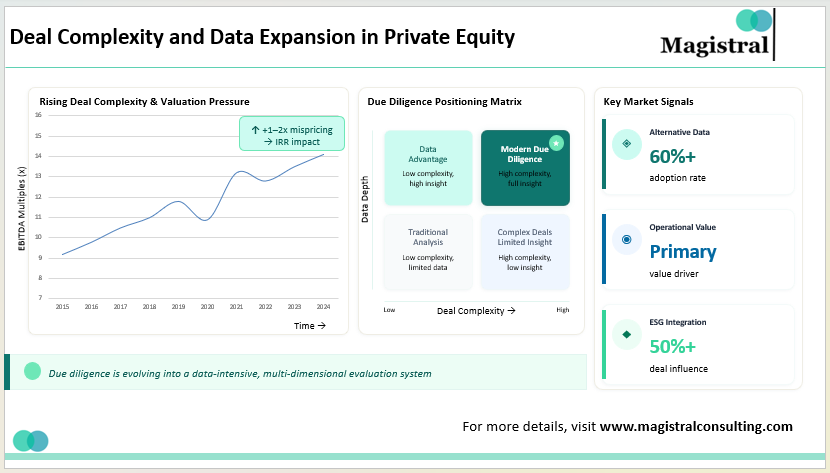
Valuation multiples continue to remain elevated. McKinsey & Company points out that EBITDA multiples in competitive sectors have grown significantly over the last decade. This increases the risk of overpaying for companies. A miscalculation in the multiple by 1-2x can have a substantial impact on the internal rate of returns (IRR). Hence, there is a need to carry out more validation in the due diligence process for private equity firms.
Expansion of alternative and unstructured data
The usage of alternative data has become mainstream. MSCI points out that more than 60% of institutional investors use alternative data sources, like web traffic, transaction data, and sentiment analysis, in their investment decision-making. This adds more scope to the due diligence process for private equity firms, who have to process unstructured data in addition to financial data.
Operational value creation as a primary driver
The focus has shifted to operational value creation rather than multiple expansion. PwC points out that operational initiatives account for a large portion of the value creation in private equity deals. Hence, operational due diligence has become an integral part of the due diligence process for private equity firms.
Increased emphasis on ESG and governance
Environmental, social, and governance concerns have become an essential part of investment decision-making. According to Deloitte, ESG concerns have an influence on over 50% of private equity investment decisions. This is another level of due diligence for private equity firms.
Designing Scalable Diligence Systems
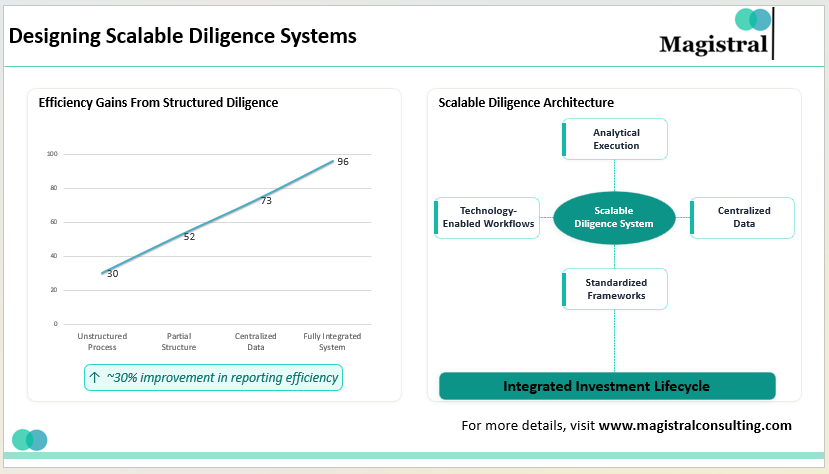
Due diligence helps a private equity firm create value if it is conducted based on a well-structured private equity operating model and framework. The private equity due diligence framework includes a clear sense of ownership and data centralization.
Designing Scalable Diligence Systems
Separation of analytical execution and decision-making
Investment teams are involved in decision-making for due diligence for private equity. The analytical teams are involved in data aggregation and validation. Industry statistics have shown that investment teams are involved in diligence activities for about 50-60% of their total activities. Structured due diligence for private equity is about decision-making and investor engagement.
Centralized data infrastructure and single source of truth
Having a centralized data infrastructure helps private equity firms maintain consistency in all due diligence activities. According to McKinsey & Company, having a centralized data framework helps companies achieve a 30% improvement in reporting efficiencies.
Standardization of diligence frameworks
Standardizing templates in financial modelling, commercial analysis, and risk assessment ensures consistency in all due diligence outputs. This ensures consistency in due diligence.
Technology-enabled diligence workflows
Technology is becoming more integrated in due diligence processes in private equity deals. Virtual data rooms and AI-based analytics are becoming more popular in due diligence.
Integration with investment lifecycle
Due diligence is no longer limited to pre-investment activities in private equity deals. It is becoming more integrated in investment deals.
Linking Diligence Quality to Investment Outcomes
Due diligence in private equity has a significant impact on key performance indicators.
Deal selection accuracy improvement
Advanced analytics play a significant role in improving decision-making in due diligence deals. McKinsey & Company has reported a 20-30 percent improvement in investment decision accuracy using data-driven decision-making.
Risk detection improvement
A structured approach in due diligence ensures early risk detection in financial, commercial, and risk assessment dimensions. According to Deloitte, firms using advanced analytics can improve risk detection by more than 25 percent in volatile markets.
Acceleration of deal timelines
Speed is a key factor in differentiating in a competitive environment. Bain & Company emphasizes that delays in evaluation can cause a significant impact on the conversion of deals. Efficient due diligence can help in accelerating deal-making.
Impact on deal conversion rates
It has been observed that there are considerable drops in deal pipelines. Industry standards have shown that only 10% to 20% of the total opportunities can progress to advanced due diligence, and less than 5% of those can result in deals. Structured due diligence for private equity can help in improving the conversion of deals.
Improved post-investment performance
Accurate due diligence can help in improving the alignment of the investment thesis. This can further help in improving performance over time.
Due diligence for private equity on governance and control mechanisms
As due diligence for private equity is becoming more complex, there is a need for effective governance mechanisms to ensure consistency, accuracy, and compliance in all aspects of due diligence.
Data validation and quality control
Accurate data is the key to successful due diligence for private equity. Structured data validation can help in achieving consistency in financial models and reports, thus reducing errors in due diligence.
Regulatory compliance alignment
Private equity firms have operations in different countries, each with different regulations. Due diligence for private equity can help in achieving compliance.
Security and confidentiality controls
Accurate due diligence for private equity requires security of sensitive information. PwC has emphasized that data security is of prime concern for investment firms. It can help in achieving security.
Standardized review and approval workflows
Review mechanisms are also structured to ensure that all diligence outputs are up to internal standards before any investment decision is made.
Process discipline and cadence
Regular pipeline reviews, milestone tracking, and workflow help in avoiding inefficiencies in the deal-making process.
Due Diligence for Private Equity as a Scalable Competitive Advantage
Due diligence is becoming a scalable function rather than a deal-specific activity. Thus, firms that develop a structured due diligence function have a significant competitive advantage in terms of efficiency and performance.
As the environment for deals is becoming more competitive, due diligence addresses the need for information processing, risk identification, and execution efficiency. Thus, over time, due diligence has transformed from a deal-specific activity to a scalable function for the entire organization. This has helped in improving deal execution efficiency, conversion rates, and overall performance.
About Magistral Consulting
Magistral Consulting has helped multiple funds and companies in outsourcing operations activities. It has service offerings for Private Equity, Venture Capital, Family Offices, Investment Banks, Asset Managers, Hedge Funds, Financial Consultants, Real Estate, REITs, RE funds, Corporates, and Portfolio companies. Its functional expertise is around Deal origination, Deal Execution, Due Diligence, Financial Modelling, Portfolio Management, and Equity Research
For setting up an appointment with a Magistral representative visit www.magistralconsulting.com/contact


Comments
Post a Comment