Venture Capital Fundraising Support to Improve Fundraising Outcomes
Venture capital fundraising support is becoming essential as fundraising efficiency declines across global markets. Bain & Company reports that global venture funding dropped by over 35% from peak 2021 levels, while Preqin data shows that the average time to close a fund has extended beyond 18–20 months. In addition, fewer funds are successfully reaching final close, indicating increasing competition for limited capital. At the same time, LPs are becoming more selective, with top-performing funds capturing a larger share of commitments. This creates a dual challenge: lower capital availability and higher execution expectations. Venture capital fundraising support addresses this gap by improving response times, structuring investor outreach, and ensuring consistency across materials. As fundraising becomes more process-driven, firms that operate with structured support systems are better positioned to maintain momentum, reduce delays, and improve close rates in competitive environments.
Venture capital fundraising support and market dynamics
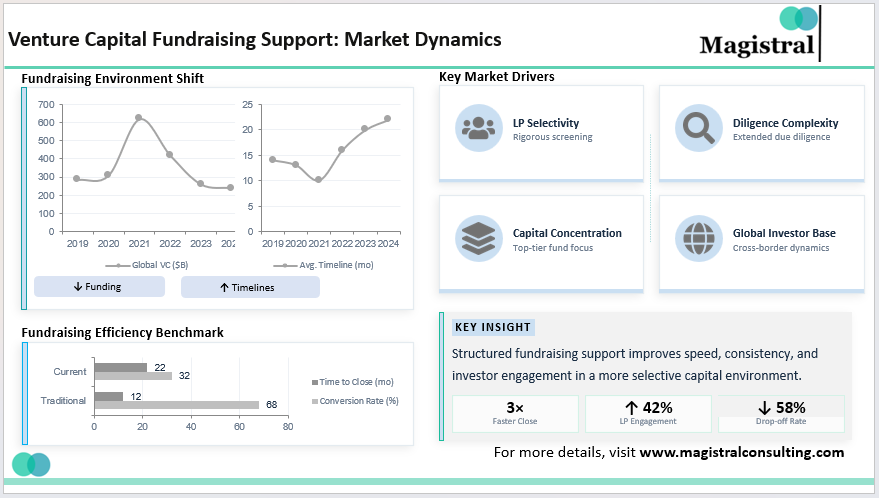
The demand for venture capital fundraising support is directly linked to measurable shifts in fundraising performance, investor behaviour, and capital concentration. These changes are not temporary but reflect structural transformation in capital allocation dynamics.
Venture Capital Fundraising Support: Market Dynamics
Declining fundraising volumes and extended timelines
Global venture funding declined significantly after 2021, with Bain estimating a drop of more than one-third in total capital deployed. At the same time, Preqin highlights that average fundraising timelines have increased from nearly 12–14 months to over 18 months, with some funds taking even longer. This elongation increases operational workload, as firms must sustain engagement across multiple investor touchpoints. Venture capital fundraising support helps manage these extended cycles by ensuring structured follow-ups, timely updates, and continuous pipeline tracking. As a result, firms reduce drop-offs and maintain investor interest over longer periods.
Increased LP selectivity and diligence requirements
Institutional investors are now more selective and analytical in their allocation decisions. Deloitte indicates that LPs evaluate funds based on a broader set of criteria, including governance frameworks, ESG alignment, and performance attribution. Furthermore, due diligence questionnaires have become more detailed, often requiring granular portfolio-level data. This significantly increases documentation workload and slows response cycles. Venture capital fundraising support improves efficiency by standardizing materials, maintaining centralized data, and enabling faster turnaround on investor queries, which directly enhances engagement levels.
Capital concentration among top-performing funds
Capital allocation is becoming increasingly concentrated among top-tier funds. Bain highlights that a smaller number of funds capture a disproportionately large share of total commitments, leaving emerging managers with limited access to capital. This concentration increases competitive pressure and requires stronger differentiation strategies. Venture capital fundraising support helps firms improve positioning by ensuring consistent messaging, structured communication, and clear articulation of investment strategy and track record across all investor interactions.
Globalization of investor base
Fundraising has become global in nature, with LPs allocating capital across geographies and asset classes. This shift requires firms to manage multiple time zones, communication cycles, and regional investor preferences. Venture capital fundraising support enables structured outreach across geographies by maintaining centralized investor pipelines and ensuring consistent follow-ups. This improves engagement across global investor bases and enhances targeting efficiency.
Venture capital fundraising support, operating model, and execution structure
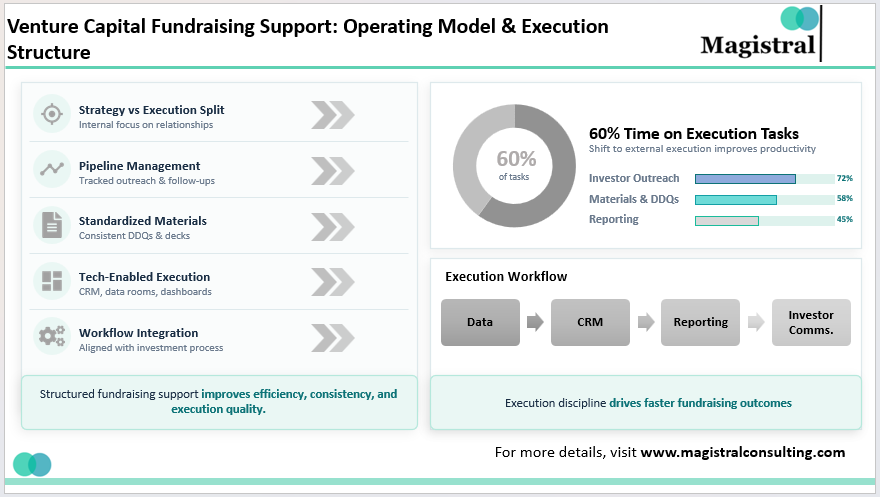
Venture capital fundraising support creates measurable value when implemented as a structured execution system rather than an ad hoc function. A well-defined operating model improves efficiency and ensures consistent outcomes.
Venture Capital Fundraising Support: Operating Model & Execution Structure
Separation of relationship and execution effort
Internal teams focus on investor relationships, negotiations, and closing activities, while execution tasks are handled externally. Industry estimates suggest that investment professionals spend nearly 60% of their time on documentation, coordination, and follow-ups. By shifting these tasks, venture capital fundraising support enables internal teams to focus on high-value activities such as relationship-building and strategic positioning, thereby improving overall productivity.
Structured pipeline management and tracking
A well-managed investor pipeline significantly improves conversion rates. Venture capital fundraising support ensures that all interactions are tracked, follow-ups are scheduled, and next steps are clearly defined. This structured approach reduces inefficiencies, minimizes missed opportunities, and improves overall pipeline visibility. Firms that maintain disciplined pipeline tracking are better positioned to prioritize high-potential investors and allocate resources effectively.
Consistency across fundraising materials
Inconsistent messaging can reduce investor confidence and delay decision-making. Standardized pitch decks, DDQs, and performance summaries ensure alignment across all communications. Venture capital fundraising support enforces version control and consistency, reducing errors and ensuring that all materials reflect the latest data and narrative.
Technology-enabled execution
Modern fundraising relies heavily on digital tools such as CRM systems, virtual data rooms, and analytics dashboards. McKinsey highlights that firms leveraging digital tools can improve operational efficiency by up to 25–30%. Venture capital fundraising support integrates these tools into daily workflows, improving response times, enhancing tracking capabilities, and ensuring better coordination across teams.
Integration with investment workflows
Fundraising increasingly aligns with broader investment functions such as private equity and portfolio monitoring. This ensures that investor communication reflects real-time portfolio insights and performance metrics. Integration across workflows improves consistency and strengthens the overall investment narrative presented to LPs.
Venture capital fundraising support impact on fundraising outcomes
The impact of venture capital fundraising support can be measured across key performance indicators such as speed, conversion rates, and investor engagement.
Improved response time and engagement
Preqin indicates that faster response times significantly improve investor engagement and increase the likelihood of conversion. Delays in communication often result in reduced interest or missed opportunities. Venture capital fundraising support ensures timely responses, maintaining momentum and strengthening investor relationships.
Reduction in fundraising cycle duration
Although market conditions influence timelines, structured execution reduces inefficiencies. Firms with disciplined workflows often close funds faster compared to those with fragmented processes. By streamlining communication and reducing bottlenecks, venture capital fundraising support contributes to shorter fundraising cycles.
Higher conversion rates across the pipeline
A structured pipeline improves visibility into investor interest levels and allows firms to focus on high probability leads. This targeted approach improves conversion rates and ensures efficient use of resources. Venture capital fundraising support plays a key role in maintaining pipeline discipline and tracking investor engagement.
Improved consistency and credibility
Consistency in communication builds trust with LPs and enhances credibility. Venture capital fundraising support ensures that all materials, responses, and updates align with the fund’s positioning and strategy. This consistency reduces confusion and improves investor confidence.
Better targeting and investor fit
Firms that adopt structured targeting strategies achieve higher success rates. Venture capital fundraising support enables better segmentation of investors based on mandate fit, geography, and investment preferences. This improves outreach effectiveness and increases the likelihood of successful fundraising.
Venture capital fundraising supports governance and process control
As fundraising becomes more structured, governance plays a critical role in maintaining control, consistency, and compliance.
Centralized data and version control
A single source of truth ensures that all stakeholders have access to the latest information. This reduces inconsistencies and prevents errors in investor communication, particularly when multiple versions of documents are involved.
Compliance and regulatory alignment
Fundraising materials must comply with regulatory requirements across jurisdictions. Structured workflows ensure that all materials are reviewed and approved before being shared with investors, reducing compliance risks.
Quality control mechanisms
Review processes ensure accuracy in performance data, track records, and financial metrics. Venture capital fundraising support enforces these controls systematically, improving data reliability and consistency.
Process discipline and cadence
Regular updates, pipeline reviews, and structured tracking mechanisms prevent process drift. Maintaining a consistent cadence ensures that all fundraising activities remain aligned with overall objectives.
Long-term capability building
Over time, venture capital fundraising support evolves into a repeatable system that enhances efficiency, scalability, and investor engagement. Firms that embed structured support into their operating model develop stronger fundraising capabilities and achieve more consistent outcomes across cycles.
About Magistral Consulting
Magistral Consulting has helped multiple funds and companies in outsourcing operations activities. It has service offerings for Private Equity, Venture Capital, Family Offices, Investment Banks, Asset Managers, Hedge Funds, Financial Consultants, Real Estate, REITs, RE funds, Corporates, and Portfolio companies. Its functional expertise is around Deal origination, Deal Execution, Due Diligence, Financial Modelling, Portfolio Management, and Equity Research
For setting up an appointment with a Magistral representative visit www.magistralconsulting.com/contact


Comments
Post a Comment