Driving Investment Edge with AI in Portfolio Management
AI in portfolio management is no longer a “nice to have” but a necessity as investment complexity rises and traditional alpha declines. With global AUM expected to reach $200 trillion by 2030 and nearly 85% of active managers underperforming benchmarks, firms are rethinking how they make investment decisions.
The use of AI in portfolio management is a solution to this problem, where the firm can enhance its ability to improve the precision of its investment decision-making process. At the same time, the firm can manage exponentially increasing data sets consistently. As background, in the context of the more data-intensive and interconnected investment marketplace, firms that are using AI in their decision-making and investment process are more likely to be able to transform information into investment alpha, as opposed to simply gathering more information.
AI in Portfolio Management and the Economics of Alpha
The economics of the investment management industry are changing, with more difficulty sustaining the traditional sources of alpha. Declining performance and increasing research costs are causing firms to look at more structured and technology-driven investment decision-making processes.
Decline in the performance of active funds
The above-mentioned trends in the long-term performance of funds indicate structural inefficiencies in conventional portfolio management techniques. S&P Global states that 85% of actively managed equity mutual funds fail to beat their benchmark in the long term. This is creating an environment for the adoption of systemic investment management.
Increasing cost of generating alpha
To generate differentiated insights, investment managers today require access to large-scale data, tools, and talent. McKinsey & Company states that investment managers are significantly increasing their spending on analytics and digital technologies. Thus, the cost of generating alpha continues to increase.
Signal to Noise Imbalance
The amount of data produced by the market is huge, but the number of signals is limited. The issue is no longer access to data but the ability to filter the noise.
The Shift towards Systemic Thinking
The use of AI in portfolio management helps create disciplined decision-making processes. AI also reduces the variability of the decision-making process, which ensures systemic thinking in the investment strategies.
AI in Portfolio Management and Signal Extraction at Scale
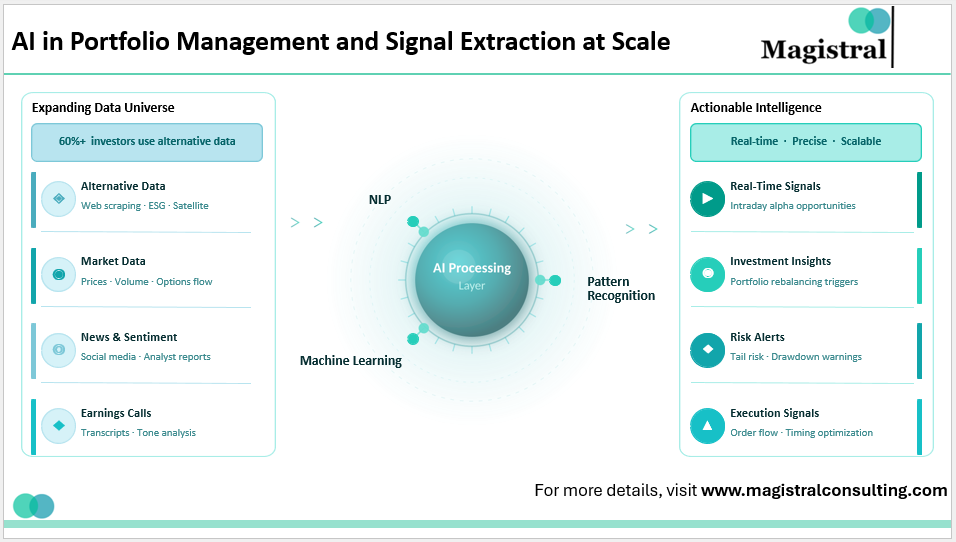
The exponential growth of data is revolutionizing the investment industry. The key to success today is the effective use of data, which is a significant competitive advantage
AI in Portfolio Management and Signal Extraction at Scale
Increasing adoption of alternative data
At present, institutional investors are using non-traditional data sets. MSCI states that over 60% of investors are using alternative data in their investment process. Non-traditional data sets can offer an alternative source of information, which is not provided by conventional financial data.
Increasing unstructured data sources
This valuable investment information is unstructured, which means it contains information such as earnings calls, news sentiment, and social media. The issue with such information is that it cannot be efficiently processed using conventional tools. This is where AI can fill in the gap.
Advanced Pattern Recognition Capabilities
Machine learning is also capable of recognizing patterns and relationships in large datasets. Such data may not be available through other channels, which could give the firm a competitive advantage.
Generation of Real-Time Insights
AI in portfolio management allows for near real-time analysis of available information. This helps the firm respond to market conditions on time, giving a competitive edge in both opportunity capture and risk management.
AI in Portfolio Management and Execution Speed Advantage
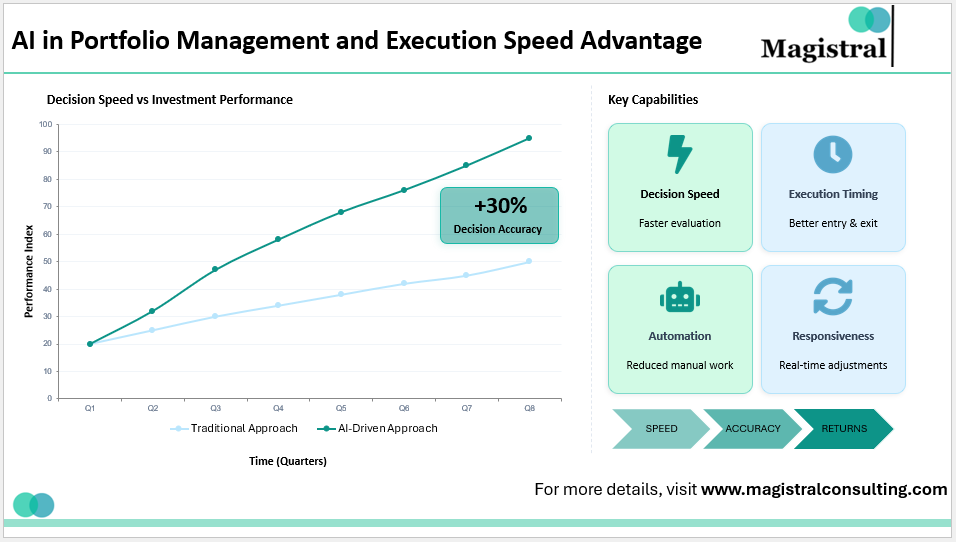
Speed is becoming a differentiating factor for investment firms. It directly impacts returns and risk management for the firm.
AI in Portfolio Management and Execution Speed Advantage
Reduction in Decision Latency
AI helps reduce the time required for the analysis of investment opportunities. According to a report by McKinsey & Company, the accuracy of decisions can be improved by up to 30% through the use of AI, along with a reduction in time required for analysis.
Improvement in Trade Execution Speed
This allows for better entry and exit of trades. In a competitive environment, even a small difference in time can result in significant returns.
Automation of Operations
AI helps automate repetitive tasks, allowing for better efficiency in operations.
Continuous Responsiveness to Market Conditions
AI helps create a system that can adapt to changing market conditions. This allows for a better alignment of the portfolio to the current environment.
AI in Portfolio Management and Cost-to-Serve Compression
As the asset management industry faces fee compression, it becomes important for firms to reduce costs while maintaining quality and depth of analysis.
Reduction in Operational Costs
AI helps automate operations, reducing the need for conventional methods. This helps reduce costs, especially as the industry faces a fee compression.
Enhanced analyst productivity
Productivity and quality of decisions are improved as AI frees the analyst to concentrate on more strategic activities and not on data management.
Scalable operating models
AI in portfolio management enables firms to grow their portfolios and complexity without proportionally increasing costs. This is essential in a high-AUM environment.
Alignment with industry fee trends
Firms in the investment management industry are forced to be more efficient in their operations as fee structures continue to fall. AI in portfolio management is essential in ensuring that the firm is cost-efficient while still meeting performance standards.
AI in Portfolio Management and the Scaling Challenge
While investment in AI is rising, most firms are still not able to scale their AI capabilities beyond the pilot project level. This is an indication of the disconnect between investment in AI and the actual implementation of AI in the firm.
High investment but limited outcomes
According to Deloitte, over 70% of investment management firms are investing in AI capabilities, but only a small percentage of them can scale their AI capabilities.
Fragmented data ecosystem
Firms in the investment management industry face challenges in implementing AI in their operations because of the fragmented data ecosystem. This makes it difficult to integrate insights and make them more effective.
Lack of integration of workflows
AI in portfolio management is often not fully effective in the investment management firm’s operations because of the lack of integration of AI in the workflows of the firm.
Lack of talent
Firms in the investment management industry lack the skills and talents of data scientists and engineers, which makes it difficult to implement AI in their operations.
Need for operating model redesign
AI in portfolio management is essential in improving the operations of investment management firms and thus the need to integrate AI in the workflows of the firm.
AI in Portfolio Management and Model Oversight Requirements
As AI becomes central to investment decision-making, the need for governance frameworks that are transparent, accurate, and regulatory-compliant arises.
Data quality and consistency
AI requires accurate and consistent input data. A structured validation process for accuracy and elimination of errors in decision-making is necessary.
Model transparency and explainability
AI models need to be transparent and explainable for investment decisions to be understandable by stakeholders.
The processes carried out by AI should be in line with financial regulations and laws. This means that financial information should be accurate, and audits should be conducted accordingly.
Cybersecurity and data protection
The financial information should be provided with top-grade security measures such as encryption, access control, and surveillance.
Human oversight and accountability
AI works in conjunction with humans, never replacing them. Investment managers are still required to validate information and align it with the larger business objectives.
About Magistral Consulting
Magistral Consulting has helped multiple funds and companies in outsourcing operations activities. It has service offerings for Private Equity, Venture Capital, Family Offices, Investment Banks, Asset Managers, Hedge Funds, Financial Consultants, Real Estate, REITs, RE funds, Corporates, and Portfolio companies. Its functional expertise is around Deal origination, Deal Execution, Due Diligence, Financial Modelling, Portfolio Management, and Equity Research
For setting up an appointment with a Magistral representative visit www.magistralconsulting.com/contact


Comments
Post a Comment